Breast Surgery

Breast Lift

Sagging Breast Surgery

Correct the cause and restore volume—all at once.

Breast sagging can be caused by many factors, including aging, childbirth, and weight changes, so a careful evaluation of each patient's condition is essential.
Based on an accurate diagnosis, we create a personalized surgical plan
to restore natural firmness, volume, and a balanced breast line.

Specialists from each field come together to discuss your surgical plan.

Specialists from each field come together to discuss your surgical plan. - procedure image
  • CHECK POINT01

    Consultation team that recommends personalized surgery

  • CHECK POINT02

    Plastic surgeons with extensive breast surgery experience

  • CHECK POINT03

    Breast surgeons who understand women's concerns

  • CHECK POINT04

    Anesthesiology team that keeps you safe

  • CHECK POINT05

    Aftercare team with certified care specialists

Medical TECH

Medical TECH - procedure image
  • CHECK POINT01

    Sagging breast correction with Dual Plane Ⅱ / Ⅲ: The dual plane technique lifts sagging breasts without additional incisions, creating a natural, smooth breast curve with implant volume alone.

  • CHECK POINT02

    Less risk of vessel and nerve damage: A high-resolution FULL HD endoscope allows precise visualization of the surgical area and meticulous tissue dissection, minimizing nerve and vessel damage and preventing bleeding-related complications.

  • CHECK POINT03

    Improved nipple balance: Rather than focusing on volume alone, we perform detailed, customized surgery that considers the position of the nipple-areola complex and the overall balance of the breasts.

  • CHECK POINT04

    Surgical approach based on anatomy: We comprehensively analyze anatomical factors such as breast size, skin elasticity, glandular tissue, and muscle development to recommend the most suitable technique.

Medical RECOMMEND

Medical RECOMMEND - procedure image
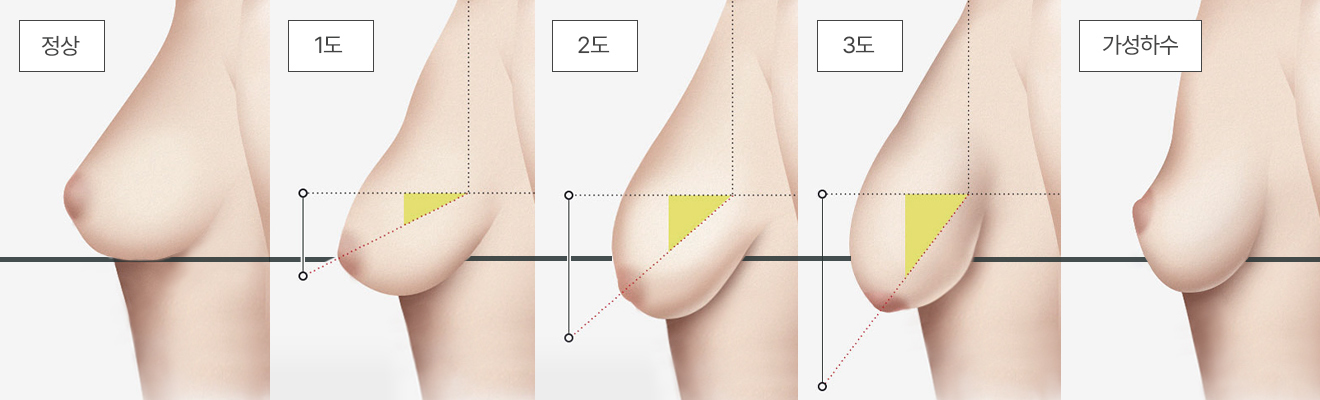
CharacteristicsDistance between nipple position
and inframammary fold
Surgical MethodLift TechniqueImprovement
NormalㅡㅡBreast augmentationㅡIncreased volume
Grade 1Mild sagging

*In some cases, breast augmentation
alone may be sufficient

Within 1 cmBreast augmentation or
Breast augmentation + lift
Crescent incisionImproved volume,
lifted areola position
Grade 2Noticeable sagging and
change in breast shape
Within 1–3 cmBreast augmentation + liftVertical incisionRestores hollowness,
lifts tissue that has
descended
Grade 3Severe sagging with
the entire breast shifted downward
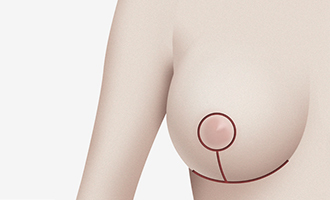
3 cm or moreBreast augmentation + liftVertical incision or anchor (inverted-T) incision

*The anchor incision is mainly used when
the inframammary fold has also changed position.

Restores hollowness,
overall lift of tissue
that has shifted downward
PseudoptosisSagging present, but
areola position is normal
ㅡBreast augmentationㅡRestores lost upper-pole volume
좌우로 슬라이드하여 확인해주세요

Surgery PROCEDURE

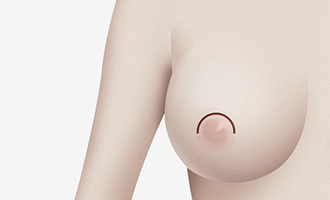
CASE 1. Crescent Incision (mild sagging)

  • Crescent incision
    case.1Crescent incision
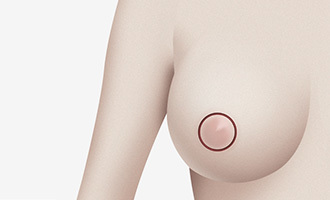
  • Periareolar Incision
    case.2Periareolar Incision
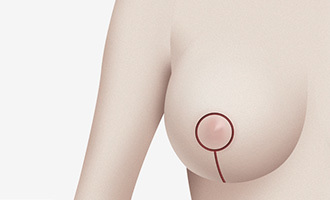
  • Vertical incision
    case.3Vertical incision
  • Anchor Incision
    case.4Anchor (Inverted-T) Incision

CASE 1. Crescent Incision (mild sagging)

An incision is made in a crescent shape above the areola, and the sagging tissue is pulled upward.
The crescent technique leaves a small scar, allows for significant tissue removal, and enables a quick recovery.

  • Crescent incision, then removal of the epidermal layer onlyCrescent incision, then removal of the epidermal layer only
  • Removal of sagging glandular tissueRemoval of sagging glandular tissue
  • Closure of the incisionClosure of the incision
  • Closure completeClosure complete

CASE 2. Periareolar Incision (mild sagging)

An incision is made around the areola to remove part of the breast tissue.
Compared with other techniques, it leaves less scarring, allows faster recovery, and suits breasts with mild sagging.

  • Incision around the areola, then removal of the epidermal layer onlyIncision around the areola, then removal of the epidermal layer only
  • Nipple is lifted upwardNipple is lifted upward
  • Excision of sagging skin and tissueExcision of sagging skin and tissue
  • Closure around the areolaClosure around the areola

CASE 3. Vertical Incision (moderate sagging)

An incision is made around the areola, followed by a vertical incision of about 4–5 cm downward.
It is a widely used technique because it can correct a significant degree of sagging.

  • Incision around the areola, then removal of the epidermal layer onlyIncision around the areola, then removal of the epidermal layer only
  • Closure of the incisionClosure of the incision
  • Excision and removal of sagging glandular and skin tissueExcision and removal of sagging glandular and skin tissue
  • Closure completeClosure complete

CASE 4. Anchor (Inverted-T) Incision (severe sagging)

The most traditional technique: incisions are made around the areola and from the nipple down to the inframammary fold,
and the sagging glandular tissue, fat, and skin are removed. It is suitable for very large, severely sagging breasts.

  • Incision around the areola and down to the inframammary fold, then removal of the epidermal layer onlyIncision around the areola and down to the inframammary fold, then removal of the epidermal layer only
  • Excision and removal of sagging glandular tissue, skin tissue, etc.Excision and removal of sagging glandular tissue, skin tissue, etc.
  • Closure of the incisionClosure of the incision
  • Closure completeClosure complete

Frequently Asked Questions

  • A. It can be considered when breast volume has decreased and the nipple position or the entire breast has dropped due to aging, childbirth, breastfeeding, weight changes, and so on.