
NANA BLOG
Double Eyelid Surgery & Ptosis Correction
Contents
Double Eyelid Surgery & Ptosis Correction : 4 Techniques at NANA Compared
Buried suture or incision? And do you also need ptosis correction? A clear guide to how NANA matches the technique to your eyelids.
Your eyes shape your first impression more than almost any other feature. That is why double eyelid surgery is not one operation but a family of techniques. At NANA Plastic Surgery in Seoul, the eye team designs an in-line, out-line, or in-out line crease around each person's eye condition, shape, and overall facial proportions, and then chooses the method that will hold that line best. For some people, a crease alone is not enough: if the eyelid muscle is weak and covers part of the pupil, ptosis correction (eye shape correction) is what makes the eyes look clear and awake. This guide explains all four techniques so you can see where your eyes might fit.
Key Takeaways
- NANA offers two double eyelid techniques: natural adhesion buried suture (Dual-Lock) and slim line incision.
- NANA offers two ptosis correction techniques: non-incisional (natural adhesion) and incisional.
- Thin, elastic eyelids often suit the buried suture method; sagging skin, heavy fat, or strong asymmetry often call for incision.
- If the eyelid covers much of the pupil, ptosis correction strengthens the eye-opening muscle so more of the iris shows.
- All four are performed under sedation anesthesia, with surgery times from about 15 minutes to 1 hour.
- The final technique is chosen after a specialist analyzes your eye structure and condition in a one-on-one consultation.
Do You Need a Double Eyelid, Ptosis Correction, or Both?
A well-formed double eyelid line does not automatically mean beautiful eyes. When the skin sags heavily or the eye-opening muscle is weak (ptosis), the eyelid covers the pupil and the eyes can look sleepy and tired. People with weak eyelid muscles also tend to lift their forehead to open their eyes, which can deepen forehead wrinkles. If that sounds familiar, read the ptosis correction sections below.
That is why NANA first looks at two separate questions: what kind of crease suits your face, and how strongly your eyelids open. The answers decide whether you need one of the two double eyelid techniques, one of the two ptosis correction techniques, or a combination.
Which Eye Technique May Suit Your Eyelids?
| What you notice | Technique often considered |
|---|---|
| Thin, elastic eyelids; want a natural look and fast recovery | Natural adhesion buried suture |
| Sagging skin, excess fat, lashes poking the eyes, sunken eyelids, or strong asymmetry | Slim line incision |
| Sleepy-looking eyes, weak eye opening, scar concerns, want fast recovery | Non-incisional ptosis correction |
| Eyelids cover the pupils with sagging skin; forehead wrinkles from lifting the brows to open the eyes | Incisional ptosis correction |
This table is a starting point only. NANA analyzes each person's eye structure and condition before deciding on the technique, and some people need a double eyelid technique combined with ptosis correction.
How Do NANA's Four Eye Techniques Compare?
| Technique | Surgery time | Anesthesia | Stitch removal | Daily life | Follow-up visits |
|---|---|---|---|---|---|
| Buried suture (Dual-Lock) | About 15 min | Sedation | None | Right away | None |
| Slim line incision | 30 to 40 min | Sedation | 5 to 7 days | After 1 to 2 days | 1 (stitch removal) |
| Non-incisional ptosis correction | 30 to 40 min | Sedation | None | Right away | None |
| Incisional ptosis correction | About 1 hour | Sedation | 5 to 7 days | After 2 to 3 days | 1 (stitch removal) |
What Is NANA's Natural Adhesion Buried Suture Method (Non-Incisional Double Eyelid Surgery)?
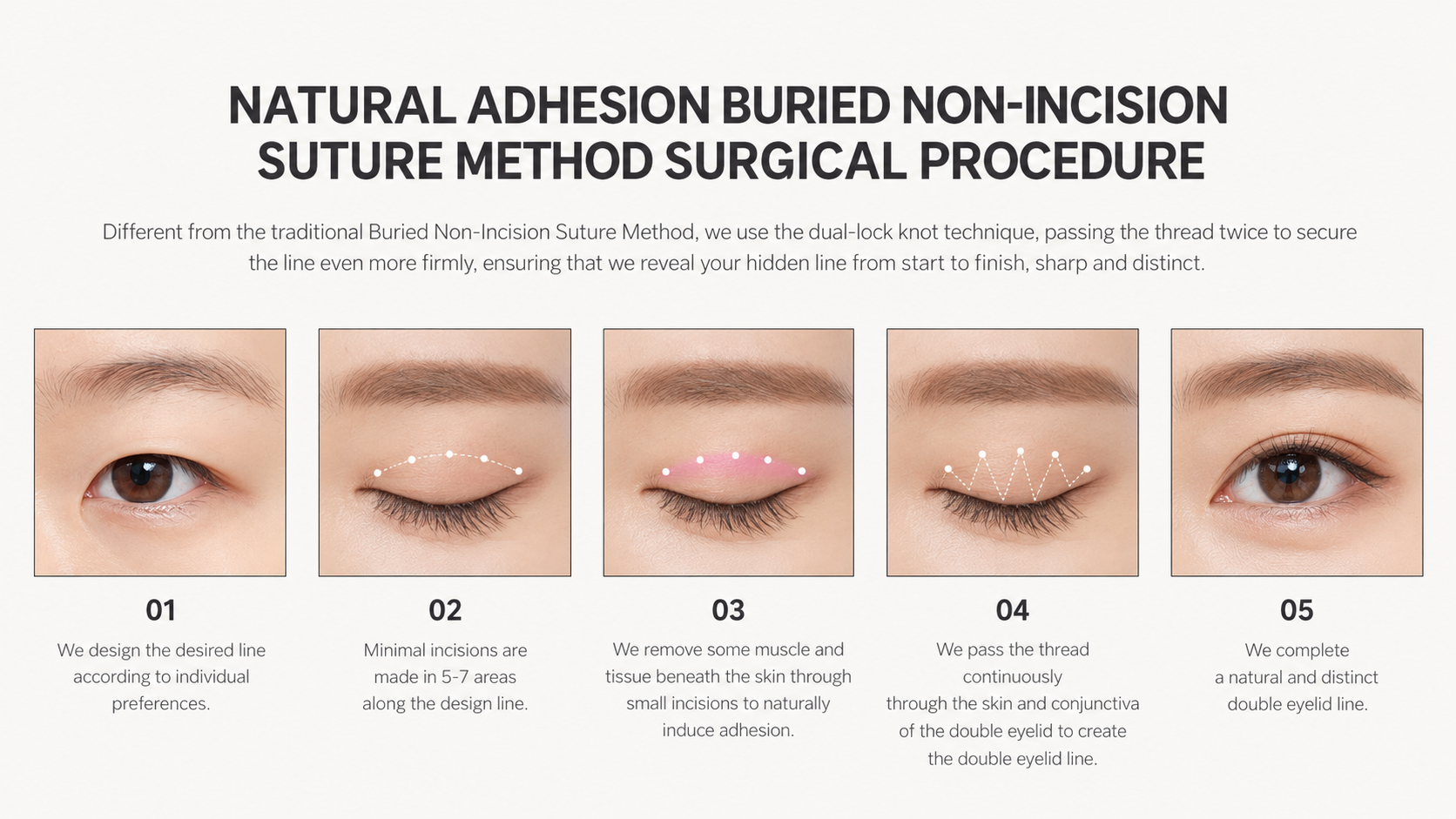
A conventional buried suture (non-incisional) method places small grooves on the line and holds the fold with thread alone. NANA's natural adhesion buried suture goes a step further. Through 5 to 7 micro-openings that follow each person's skin texture, part of the tissue between the skin and the levator muscle (the muscle that opens the eye) is removed, and the thread is knotted twice to encourage natural adhesion between them. NANA has filed a trademark application for this Dual-Lock knotting technique with the Korean Intellectual Property Office.
How It Is Performed
Why It Stands Out
- Little scarring concern: the surgery uses small openings and is fixed on the inner side of the eyelid, so scars are hardly visible.
- Less loosening: natural adhesion, continuous suturing, and special thread help minimize the fold coming undone.
- Quick return to daily life: surgery is short, there are no stitches to remove, and recovery is fast.
Who It May Suit
- People who want a natural-looking eye shape
- People who feel the incision method is too much
- People with thin, elastic eyelids
- People worried about incision scars
- People who want a fast return to daily life
After a buried suture, the thread guides the line and adhesion forms along it over time. To protect it, avoid rubbing your eyes hard and protect them from injury: strong rubbing can loosen the adhered area, and a hard impact can increase bruising or swelling.
Not sure whether your eyelids suit the buried suture or incision method? Send us photos from the front, 45 degrees, and side, and our English-speaking team will review them with the doctors.
What Is Slim Line Incision Double Eyelid Surgery?
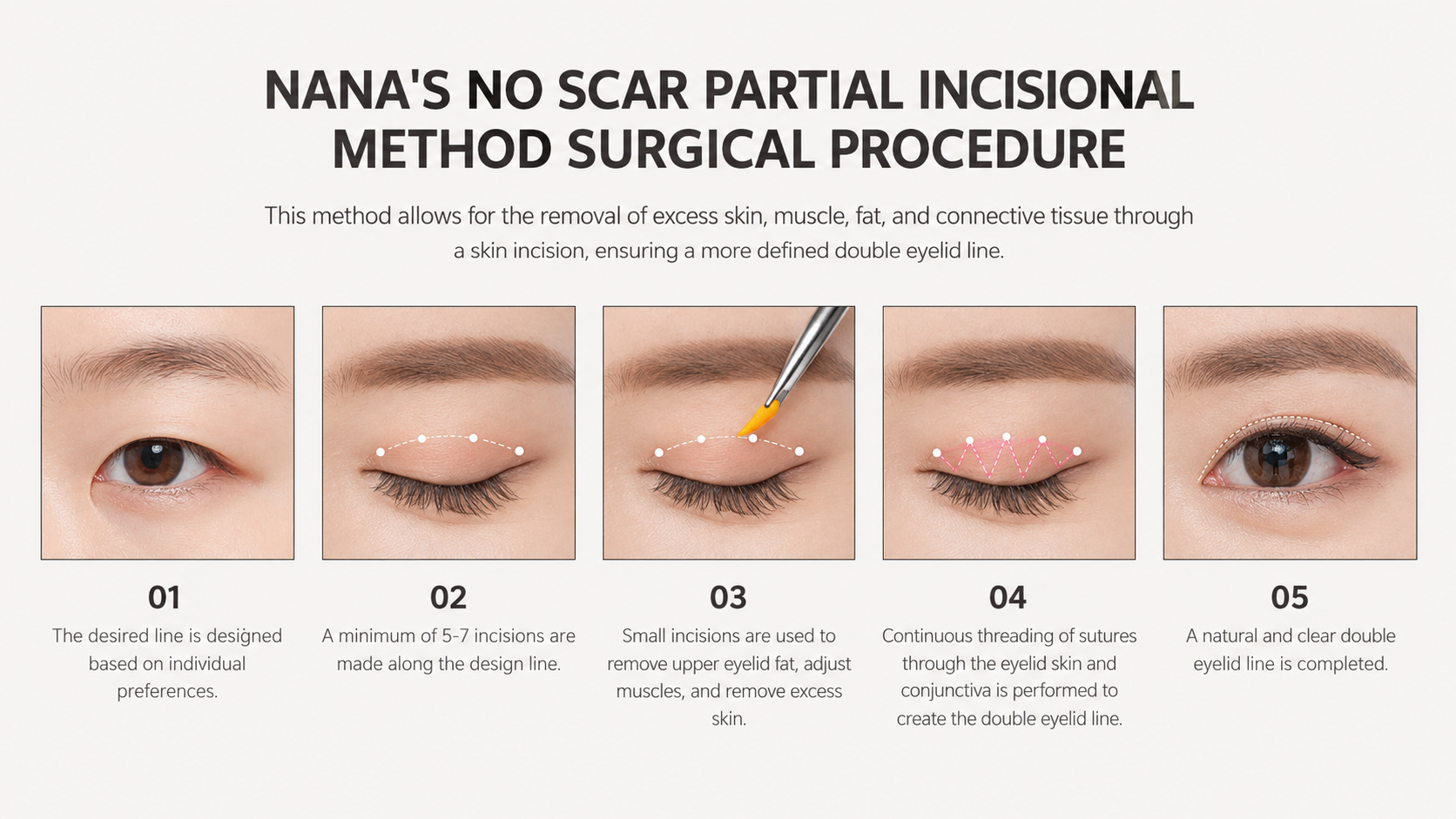
Many people hear “incision” and worry about scars or swelling. When a skilled specialist operates precisely, however, the incision method can produce a natural, ideal eye shape that rarely comes undone. NANA's slim line incision removes sagging skin and excess fat and, if the eyelid muscle is thick and well developed, corrects that too, creating a slim, natural crease for almost any eye.
How It Is Performed
Why It Stands Out
- More can be done through the incision, including fat removal, skin excision, and eye-shape correction.
- Customized to your eyelid: sagging skin is trimmed to create a line of the size you want.
- A secure fold that is less likely to loosen than other methods.
- Thick eyelids made slimmer by removing eyelid fat.
- Asymmetry correction by varying the amount of skin and fat removed on each side.
- Careful post-operative care to support a satisfying recovery.
Who It May Suit
- People whose eyes look heavy because of sagging skin or excess fat
- People who want a clearly defined double eyelid
- People whose eyelashes poke into the eyes
- People worried about the fold coming undone
- People with significant asymmetry between the eyes
- People whose upper eyelids are sunken, making the line hard to hold
Some people prefer the buried suture method to avoid swelling or scars. But if the eyes are droopy or sunken, or the eyelids are thick with a lot of fat and skin, a buried suture can loosen quickly and the fold can become thick like a sausage. That is why a one-on-one consultation based on your eye condition comes first.
What Is Non-Incisional Ptosis Correction?
Non-incisional ptosis correction guides the double eyelid into natural adhesion in the shape you want while also making the eye-opening muscle stronger. Because no incision is made, swelling after surgery is minimal and recovery is short. A specialized double fixation method holds the muscle firmly so the line does not come undone.
How It Is Performed
- Small openings are made at 5 to 7 points along the designed line.
- Some tissue is removed through these openings to encourage natural adhesion.
- Thread is passed continuously through the eyelid skin and conjunctiva to form the crease.
- Through a small opening, the eye-opening muscle is tied from the conjunctival side to strengthen eye opening.
- A larger, clearer, ideal eye shape is completed.
Why It Stands Out
- Fixation that holds: NANA's double fixation method secures the muscle firmly.
- A clearer eye shape: the eye-opening muscle is shortened through a small opening.
- Minimal scarring, swelling, and downtime, so daily life can continue right away.
Who It May Suit
- People worried about scars who want a fast recovery
- People whose eyelids cover much of the pupil, giving a sleepy look
- People who rely on the forehead to open their eyes because the eyelid muscle is weak
- People who already have a double eyelid but still look sleepy
- People with uneven eyes because each eyelid opens with different strength
What Is Incisional Ptosis Correction?
When skin sagging is significant or ptosis has weakened the eye-opening muscle considerably, the eyelid covers the pupil and the eyes look sleepy and tired. Incisional ptosis correction increases how much of the pupil is visible, giving a clearer and more defined eye. NANA considers each person's facial proportions and length and combines several techniques to find the eye shape that suits them best.
How It Is Performed
- The desired line is designed according to your preference.
- Unnecessary muscle or fat is removed along the designed line.
- The eye-opening muscle is tied to match the strength of eye opening, then sutured.
- A natural, clear eye shape is completed.
Why It Stands Out
- Design based on detailed diagnosis: both the shape of the eye and functional problems are assessed for an accurate plan.
- Fat removal and skin excision as needed to turn thick, puffy eyelids into a sharper shape.
- Reliably stronger eye opening, with a lower chance of the fold loosening or the eyelids weakening again.
- Asymmetry correction by varying the amount of skin and fat removed on each side.
- Careful post-operative care to support a satisfying recovery.
Who It May Suit
- People whose eyelids cover the pupils, giving a very sleepy look
- People whose forehead is wrinkled from using it to open the eyes
- People who have a double eyelid but want to change sleepy-looking eyes into clearer ones
- People with strongly uneven eyes because each eye opens with very different strength
- People whose upper eyelids look sunken and tired because the eyes do not open well
If ptosis is present but only double eyelid surgery is done, because of cost or scar concerns, the fold can end up too thick or settle asymmetrically. With little of the pupil visible, the eyes can even look smaller, or the surgery may show little change. Combining ptosis correction based on a specialist's analysis of the cause is what leads to a satisfying eye shape.
Does a Bigger Double Eyelid Fold Make Your Eyes Look Bigger?
Some people ask for a higher line to “allow” for future eyelid sagging. Doing so means living with the same drawbacks now. It is usually better to choose a line that suits your eyes today and, if sagging develops with age, to have the surgery that fits your eye condition at that point.
What Happens on the Day of Surgery?
- Visit NANA Plastic Surgery in Apgujeong, Gangnam, Seoul.
- Consult with an eye surgery specialist and design your line.
- Surgery: about 15 minutes for buried suture, 30 to 40 minutes for slim line incision or non-incisional ptosis correction, and about 1 hour for incisional ptosis correction.
- Go home the same day and follow the aftercare guide below.
How Should You Care for Your Eyes After Surgery?
NANA runs a structured aftercare program. These are the six points every eye surgery patient should know.
1. Washing, Showering, and Makeup
You can wash your hair and shower from the day after surgery, but keep water off the wounds. Straining your eyes can cause pooled blood to come out, so take care. Eye makeup and contact lenses are possible after about 4 weeks: avoiding eye makeup for a month helps keep the fold from loosening or changing shape, and lenses can irritate the conjunctiva before then.
2. What to Expect in Recovery
Conjunctival swelling (the conjunctiva looks white and puffy) or redness can appear after surgery. These are common and are naturally absorbed over 2 to 4 weeks. A temporary increase in tears or eye discharge is also a normal reaction that improves with time.
3. Managing Swelling
Swelling decreases over 3 to 6 months. It is normal for the two sides to swell or settle differently and look temporarily asymmetric; this improves as the swelling resolves. Use cold compresses for the first 3 days to help prevent bleeding and reduce swelling, then switch to warm compresses from day 4 for more effective swelling and bruise care.
4. Wound Care
Apply eye ointment thinly to the surgical area morning and evening with a clean cotton swab. If eye drops are prescribed, use them 2 to 3 times a day. Small white milia, about the size of a grain, can form along an incision line; they usually disappear on their own, and if they remain after 3 months they can be removed simply at the clinic depending on their condition.
5. Alcohol and Smoking
Avoid alcohol and smoking for 1 month after surgery, as both can affect bleeding, wound healing, and infection.
6. Sleeping Position
For the first week, keep your neck from bending while you sleep and raise your upper body so your head stays above your heart, which helps swelling go down faster. Sleep facing the ceiling rather than on your side or stomach, and check your sleeping position for up to 3 months.
How Does NANA Keep Eye Surgery Safe and Natural?
NANA aims for eyes that are larger and more beautiful while still looking natural, with minimal scarring and proportions that suit your face.
Personalized Eye Design
Each design considers your eye condition and shape, harmony with your face, and your preferences, minimizing weaknesses and bringing out strengths.
Surgeon Name Disclosure
NANA transparently discloses the name of the operating surgeon to help prevent medical accidents and support post-operative care.
One Dedicated Medical Team
The same medical team takes responsibility from consultation through surgery and recovery care, for a safer, more complete result.
Safety Systems and Care Center
A safe anesthesia system and uninterruptible power system support the operating rooms, and a care center provides recovery and swelling management.
Frequently Asked Questions About Double Eyelid Surgery and Ptosis Correction
How do I know whether I need the buried suture or the incision method?
Will a bigger double eyelid fold make my eyes look bigger?
What should I be careful about after buried suture double eyelid surgery?
Can drooping eyelids affect vision?
Is a tight feeling normal after ptosis correction?
What happens if I have ptosis but only get double eyelid surgery?
When can I wear eye makeup and contact lenses after eye surgery?
How long does swelling last after double eyelid surgery?
The right double eyelid technique depends on your eyelid thickness, fat, skin, and how strongly your eyes open. Whether you need a buried suture, an incision, ptosis correction, or a combination, a personalized consultation with photos lets NANA's eye team design a line that looks natural on your face. You can also browse outcomes on the NANA before and after page or read more questions in the FAQ above.
WhatsApp: +82 10 9470-0591 · Instagram: @nanahospital_eng
Medical Disclaimer: This article is for general informational purposes only and does not constitute medical advice. All surgical procedures carry risks, and suitability can only be determined through a personal consultation with a board-certified plastic surgeon at NANA Plastic Surgery. Individual results vary.