NANA BLOG
Endoscopic Forehead Lift in Korea
Contents
Endoscopic Forehead Lift in Korea
Forehead lines and drooping eyelids treated together, through an incision of 1 to 2 cm hidden inside the hairline.
Written and reviewed by the surgical team at NANA Plastic Surgery in Seoul, based on the clinic's own forehead lifting protocol.

Hello everyone. This is NANA Plastic Surgery in Cheongdam-dong, Gangnam-gu, Seoul.
As we age, the eyelids begin to droop. To open the eyes, the forehead muscles are recruited to lift the sagging eyelid, and over time the skin and muscle of the forehead stretch. Deep lines form, and the forehead starts to look dark and heavy.
NANA's endoscopic forehead lift improves on the older surgical method, which required a scalp incision that left a long scar and caused hair loss. Instead, the tissue is released through a small incision of about 1 to 2 cm and the work is carried out with an endoscope, so almost no scar remains while the lifting effect stays clear. You can also read the full forehead lift procedure page for the clinical overview.
Key Takeaways
- The incision is only about 1 to 2 cm, made inside the hairline, and the lift is carried out with an endoscope.
- The lifted tissue is held with Endotine, an absorbable implant approved by the US FDA and licensed by the Korean MFDS.
- It lifts the whole forehead evenly, improving eyelid droop, forehead lines and glabellar lines.
- Surgery takes about one hour under sedation or general anesthesia, with stitches out after a week.
- Most patients return to daily life in one to two days, with one scheduled clinic visit.
- Swelling settles largely within a week, with residual swelling easing over three to six months.
What Is an Endoscopic Forehead Lift?
Through that small opening, an endoscope guides the release of the forehead tissue, which is then lifted and secured in its new position. The conventional approach relied on a scalp incision that left a long scar and caused hair loss along the incision line, and it is that trade-off, more than the lift itself, that discouraged many patients from forehead surgery in the past.
Because the working incision is so small and sits within the hair, the same lifting result can be achieved without that visible cost. At NANA in Gangnam, this is the method used for patients whose forehead and brow position are the main concern, rather than a broader facelift.
What Is Endotine and Why Is It Used?
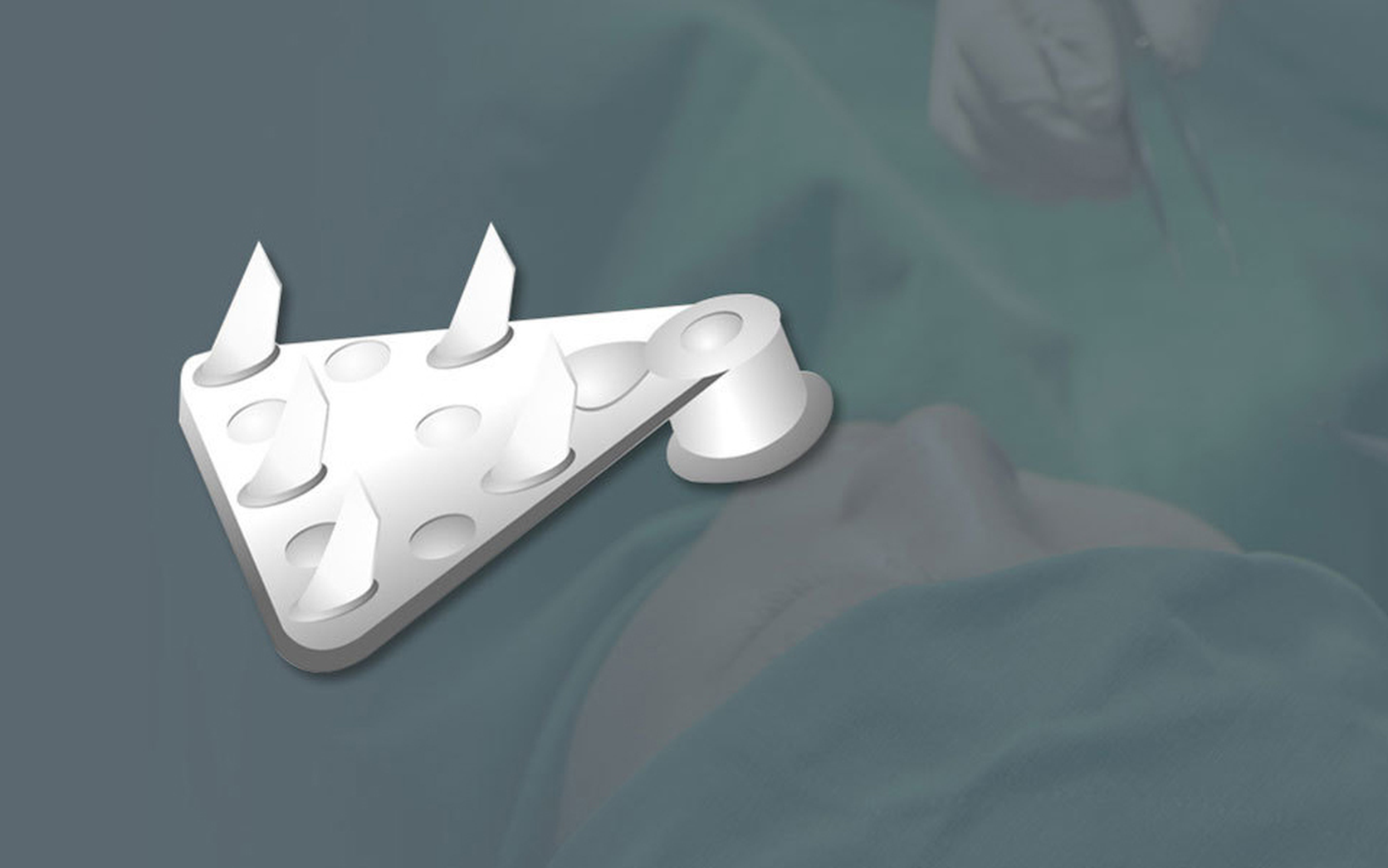
It is approved by the US FDA and licensed by the Korean Ministry of Food and Drug Safety, which is what underwrites its safety profile as an implanted material.
As a lifting material it needs no sutures, and it can be applied broadly and directed exactly where the lift is wanted. That directional freedom is what allows the whole forehead to be raised evenly rather than pulled from a single point.
Endotine is bioabsorbable. It breaks down and is absorbed by the body within six to twelve months, which is why inflammation and similar side effects rarely occur.
How Is an Endoscopic Forehead Lift Performed?
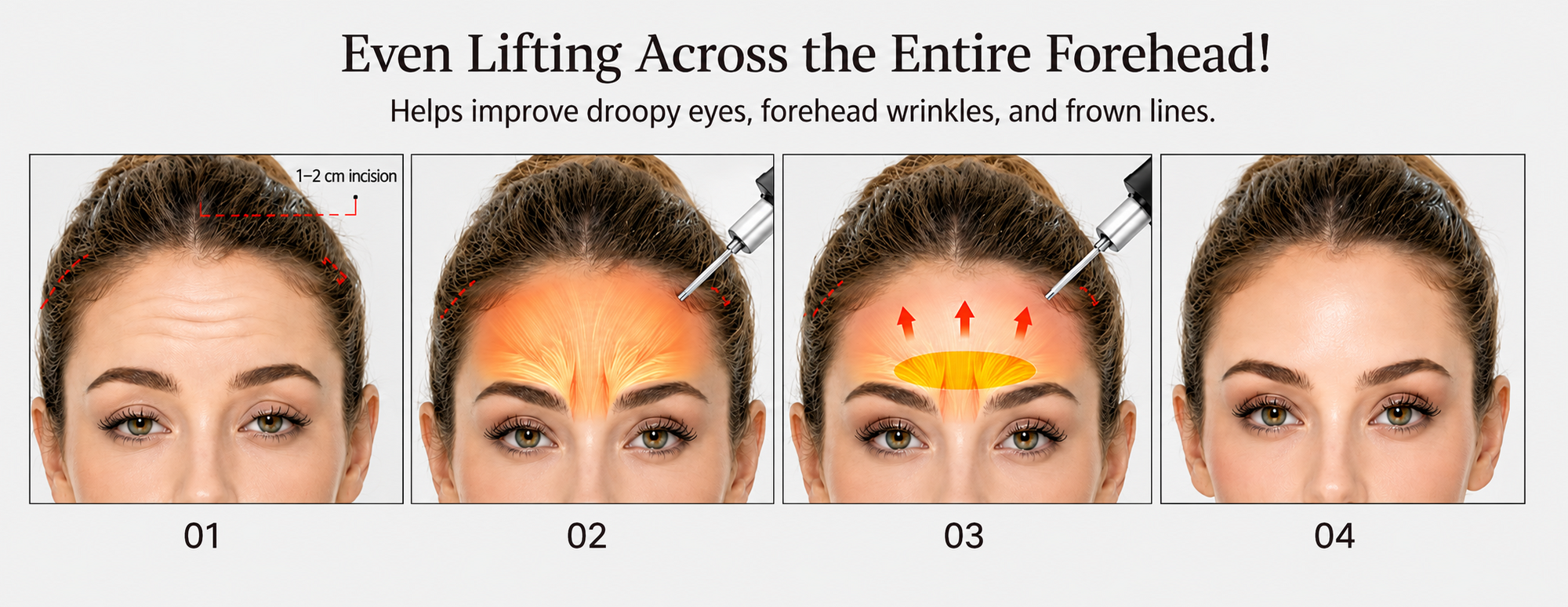
The aim throughout is to lift the entire forehead evenly, improving eye droop, forehead lines and the lines between the brows together rather than one at a time.
| Step | What happens |
|---|---|
| 01 | An incision of about 1 to 2 cm is made inside the hairline. |
| 02 | An endoscope is inserted through the incision and the forehead is released evenly. |
| 03 | The sagging area is drawn upward and fixed with Endotine, which distributes the tension. |
| 04 | The result is a more youthful facial shape than before, with a semi-permanent effect. |
How Long Does the Surgery and Recovery Take?
| Operating time | About 1 hour |
|---|---|
| Anesthesia | Sedation or general anesthesia |
| Stitch removal | After 1 week |
| Return to daily life | After 1 to 2 days |
| Clinic visits | 1 visit |
For patients travelling to Seoul, the one week to stitch removal is the figure that usually shapes the trip, since the single scheduled visit and the stitch removal can be planned around it.
Not sure whether a forehead lift is what your case needs? Send us your photos and our English-speaking team will review them with the doctors, with no obligation.
Who Is an Endoscopic Forehead Lift For?
An endoscopic forehead lift may suit you if you recognize yourself in any of the following.
- Drooping eyes with a short distance between the eye and the eyebrow
- Thickened upper eyelids after double eyelid surgery, giving a strong impression
- Descended eyebrows that make the eyes feel heavy to open and create a downcast look
- Frequent use of the brow and forehead muscles because of eye droop
- Deep lines on the forehead or between the brows
- Concern about looking severe after double eyelid surgery
Before recommending a method, the skin's degree of aging, bone structure, facial proportion and extent of sagging are analyzed so the most suitable approach can be chosen. Where the concern sits closer to the eyelid than the forehead itself, a brow lift may be discussed instead at consultation.
What Defines NANA's Endoscopic Forehead Lift?
Short procedure, quick return to daily life
Minimal skin incision means less concern about scarring and a fast return to everyday routines after surgery.
Higher effect, lower chance of revision
The skin and the fascial layer are drawn with sutures, raising the effect while lowering the likelihood of revision surgery.
Planned individually
Muscle and fat volume as well as skin elasticity differ from person to person, so the procedure is planned one to one for each patient.
Lifting and firmness together
Unnecessary fat is removed and collagen production is stimulated, so firmer skin and a lifting effect can be obtained at the same time.
A forehead that has lost firmness, refreshed
The brows, forehead and glabellar lines are drawn upward for a noticeably younger impression.
Natural results without visible scarring
Scarring is minimal, so the result does not announce that surgery was performed.
The Lifting System Behind the Surgery
Comprehensive Pre-Operative Screening
A comprehensive examination is carried out on the clinic's medical equipment system before surgery. Condition-specific screening covering more than fifty nationally certified test items is used to analyze each patient's health data before a plan is set.
Collaboration Across Specialties
Specialists in each field review the whole surgical process together beforehand, and an experienced dedicated surgical team carries it out.
Anesthesiology Specialist On Site
An anesthesiology and pain medicine specialist monitors each patient one to one, from before surgery through recovery, on an advanced monitoring system.
Recovery Management Program
A total recovery care program, including swelling management, supports a faster and more comfortable recovery.
What Are the Aftercare Instructions After a Forehead Lift?
Please read the following carefully and follow it closely for a healthier and better result.
| Timeframe | What to expect |
|---|---|
| First 3 days | Face swells. Cold compresses are recommended to limit bleeding and swelling. |
| 1 to 2 days | Most patients return to daily life. |
| First 1 week | Sleep face up with the head above the heart. Stitches are removed at one week and most major swelling settles. |
| 1 to 2 weeks | Bruising may persist depending on constitution. Keep it out of direct sunlight. |
| 1 month | No alcohol and no smoking. |
| 3 to 6 months | Residual swelling decreases gradually. |
Washing, showering and makeup
Simple shampooing is possible once the forehead bandage has been removed. Even if the stitches are still in place, you may shampoo gently after the bandage comes off. Clean the treated area carefully and dry it with cool air.
Use warm and cold compresses at the right stage. Cold compresses are recommended for the first three days while the face is swelling, since they help prevent bleeding and reduce the swelling that develops.
What to expect as you heal
Bruising can appear and may last one to two weeks depending on your constitution. Direct sunlight on a bruise can lead to pigmentation, so wear a hat or use sunscreen until the bruising has cleared.
You may feel tenderness at the Endotine fixation point, and it may be palpable. This is temporary and improves gradually, so there is no need to be concerned.
Irritating the surgical site can cause bleeding or a hematoma. Avoid anything that puts pressure on the area or raises blood pressure, such as coughing, sneezing or bending the head down.
Managing swelling
Swelling reduces over three to six months. Most of the significant swelling settles within about a week, and the residual swelling then decreases gradually over the following three to six months.
It is normal for the two sides to swell or settle unevenly and to look asymmetric for a while. That apparent asymmetry improves with time, until the swelling has fully resolved.
The eyes usually swell more than the forehead, so apply compresses around the eye area. If fat grafting was performed at the same time, use cold compresses only for two weeks, because heat interferes with the survival of the grafted fat.
Alcohol and smoking
Avoid alcohol and smoking for one month after surgery. Both adversely affect bleeding, wound healing and infection, so they are best avoided for a month.
Sleeping position
Check your sleeping posture after surgery. For the first week, avoid bending the neck while sleeping and keep the upper body raised so the head stays above the heart, which helps swelling drain faster.
Do not sleep on your side or on your stomach. Sleep facing the ceiling.
Frequently Asked Questions
What is an endoscopic forehead lift?
What results can I expect?
Will the scar be large?
What is Endotine?
How long does the surgery take, and when can I return to daily life?
What type of anesthesia is used?
When can I wash my hair?
How long does the swelling last?
How long does bruising last?
Can I feel the Endotine after surgery?
How should I sleep after surgery?
Can I drink alcohol or smoke after surgery?
If you are considering an endoscopic forehead lift in Korea, a personalized consultation can determine whether it is the right method for your anatomy and your goals.
Best,
NANA
NANA Plastic Surgery, 78-14 Cheongdam-dong, Gangnam-gu, Seoul, in front of Exit 3 of Apgujeong Rodeo Station. Monday to Saturday, 09:30 to 19:00. Closed Sundays and public holidays.
WhatsApp: +82 10 9470-0591 · Instagram: @nanahospital_eng
Medical Disclaimer: This article is for general informational purposes only and does not constitute medical advice. All surgical procedures carry risks, and suitability can only be determined through a personal consultation with a board-certified plastic surgeon at NANA Plastic Surgery. Individual results vary.