
NANA BLOG
Deeper Than Skin: The Ponytail Lift at NANA Plastic Surgery
Contents
Deeper Than Skin:
The Ponytail Lift at NANA Plastic Surgery
Inside the endoscopic deep-plane technique used at our Apgujeong clinic in Seoul: how releasing the retaining ligaments lets the brows, outer eyes, and midface be repositioned vertically, not pulled sideways.

This guide covers the surgical technique in depth. For a general overview of what the procedure achieves, see Natural Lift, Refreshed Eyes: Ponytail Lifting at NANA.
When the hair is pulled back into a tight ponytail, the brows lift, the outer eyes open, and the cheeks sit a little higher. The Ponytail Lift is built around that same effect, achieved surgically rather than temporarily. It is a facial rejuvenation procedure that focuses on the upper and middle face, including the forehead, brows, outer eyes, upper eyelids, temples, and cheeks. Depending on the patient's needs, the plan may also include additional contouring around the jawline or lower face. For anyone researching facial lifting in Korea, it is one of the procedures international patients most often compare when weighing anti-aging surgery in Seoul against options at home.
At NANA, the Ponytail Lift is performed as an endoscopic deep-plane technique. Small, discreet incisions hidden around the scalp or hairline, combined with specialized instruments, allow access to the deeper facial tissues. Rather than simply tightening the skin, the goal is to lift and reposition the deeper facial structures in a more vertical direction, which helps create a natural-looking result instead of a pulled or overly tight appearance. This is what separates it from a thread lift, which works at the surface and fades.
Key Takeaways
- The Ponytail Lift is an endoscopic deep-plane lift that targets the brows, outer eyes, temples, and midface.
- Access is through a small incision of approximately 3 cm inside the hairline near the temple, so scars stay hidden.
- The tissue beneath the SMAS layer is separated and the cheekbone retaining ligaments are released for a more effective lift.
- Deeper tissues are repositioned vertically rather than pulled sideways, which supports a natural result.
- It is not a thread lift. Threads create a temporary effect, while this is a surgical lift of the deeper layers.
- Best suited to mild to moderate sagging without a large amount of excess skin, often patients in their 30s and 40s.
What NANA's Ponytail Lift Does
NANA's Ponytail Lift is a highly customized endoscopic deep-plane lift focused on creating a natural upward lift of the brows, eyes, and cheeks with discreet incision placement. The lifted effect resembles the look created when the hair is pulled tightly into a ponytail, elevating the outer eye area, the midface, the nasolabial folds, and early lower-face sagging. Patients whose concerns sit higher on the face sometimes combine it with a forehead lift.
Unlike procedures that only tighten the skin or rely on threads, the Ponytail Lift focuses on carefully separating the tissue beneath the SMAS layer and releasing the cheekbone ligaments to create a more effective lifting result. Because the procedure is performed with the assistance of an endoscope, it allows for a more precise approach and may support a smoother recovery process.
Why Releasing the Retaining Ligaments Matters
Retaining ligaments hold the skin and facial fat in place. As aging progresses, these ligaments and the surrounding tissues loosen, and the cheeks, nasolabial folds, marionette lines, and jawline begin to sag downward.
For a more effective lift, the retaining ligaments beneath the SMAS layer must be carefully released. This allows the facial tissues to move upward more naturally instead of simply tightening the surface of the skin. The retaining ligaments around the cheekbone area are particularly strong, so releasing that area properly is important for improving deep nasolabial folds and lifting the midface.
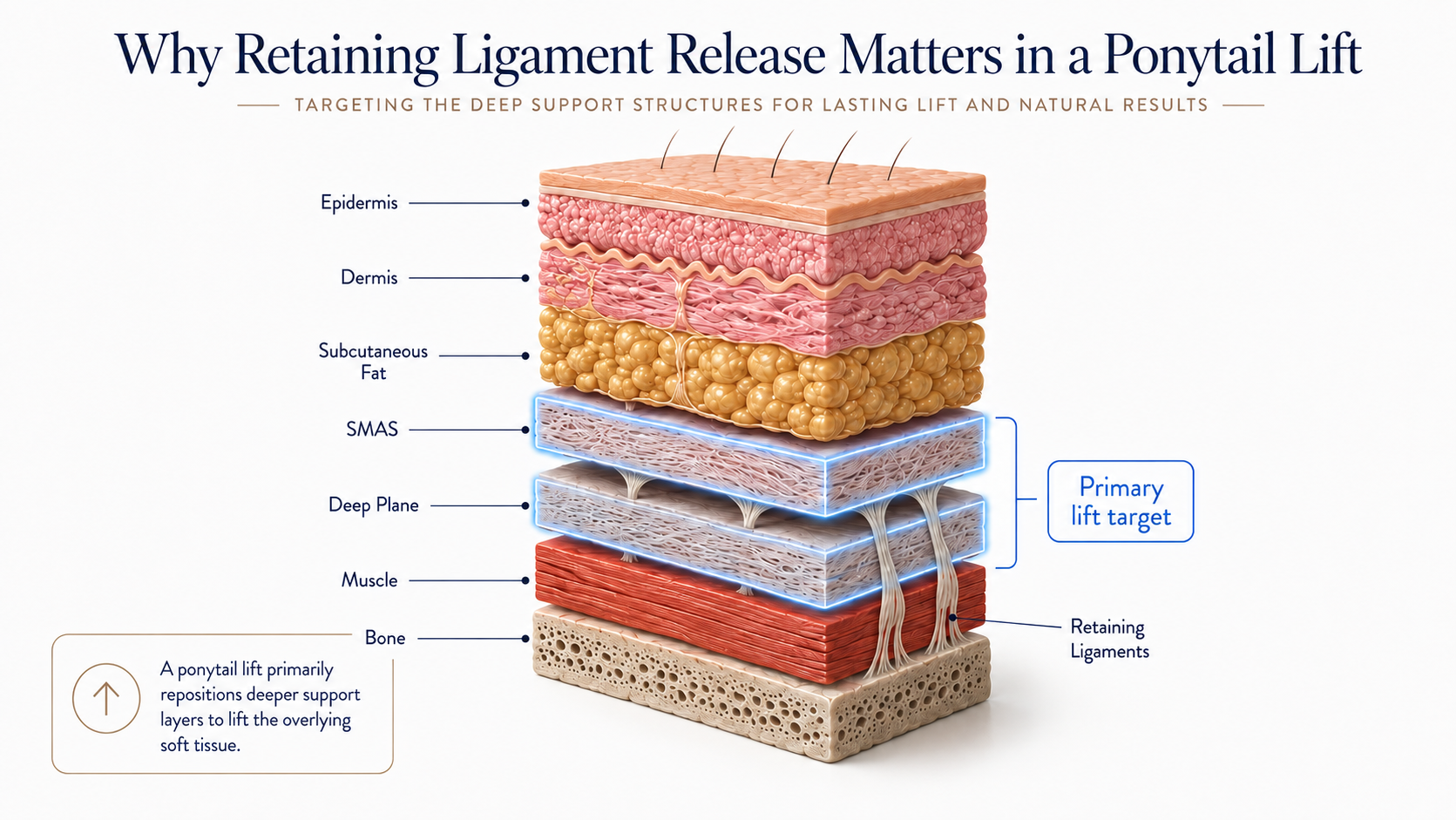 This diagram shows how a ponytail lift works beneath the skin by releasing key retaining ligaments and repositioning the deeper SMAS and support layers upward for a more natural-looking lift.
Exclusive Techniques at NANA
Hidden Hairline Incision
An incision of approximately 3 cm is placed inside the hairline near the temple, so it stays well concealed.
Accurate Endoscopic Release
An endoscope gives a clearer view of the internal structures while working through a limited incision area.
Natural Upward Lift
Deeper tissues are repositioned in a more vertical direction, so the face looks lifted rather than artificial.
How the Surgery Is Performed
The technique is designed to lift the deeper layers of the face while keeping incisions discreet and the result recognizably your own. Three points capture how that is achieved.
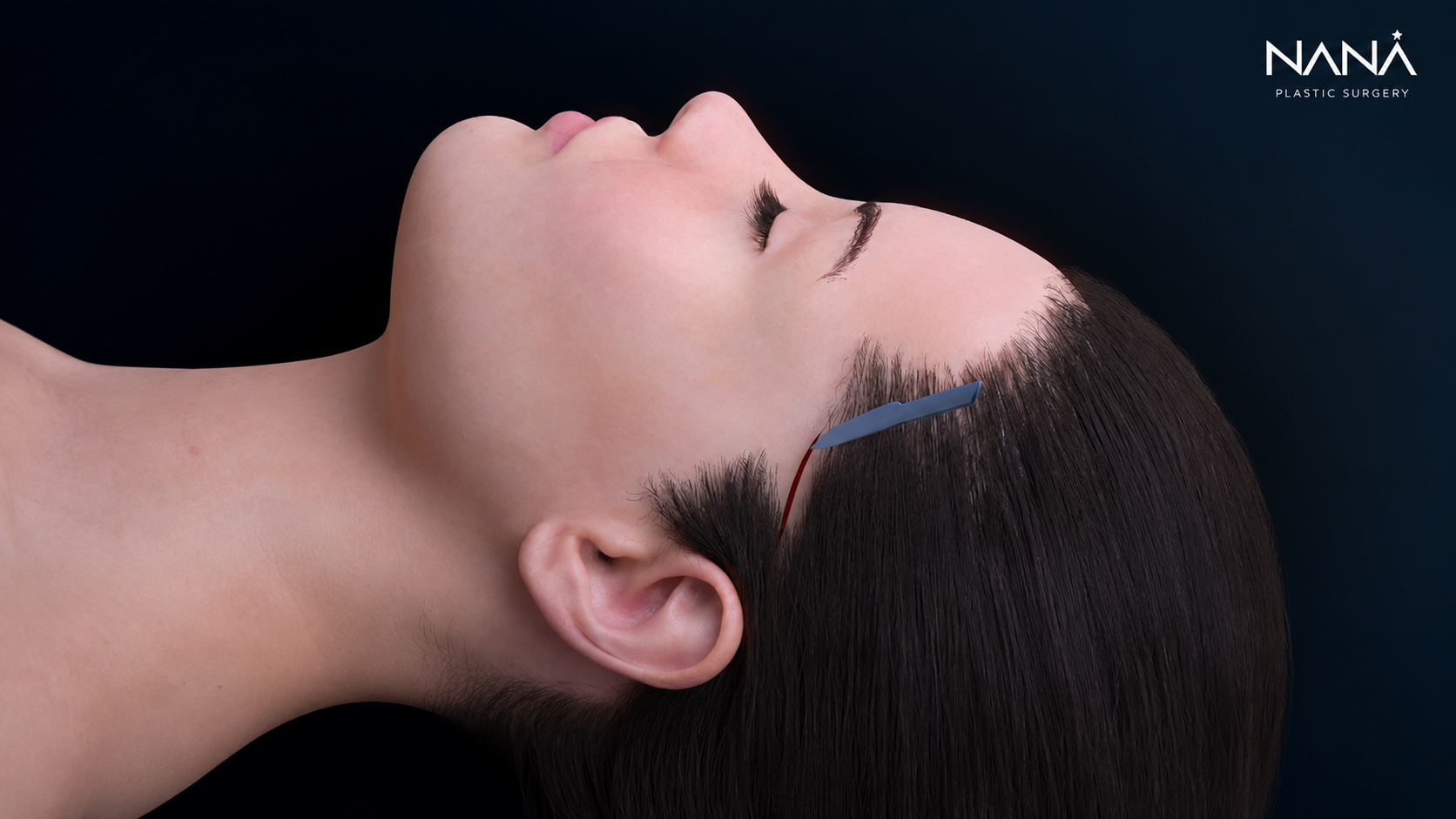
Incision placement. A small incision of approximately 3 cm is placed inside the hairline near the temple, which may suit patients concerned about visible scars around the ears or face.
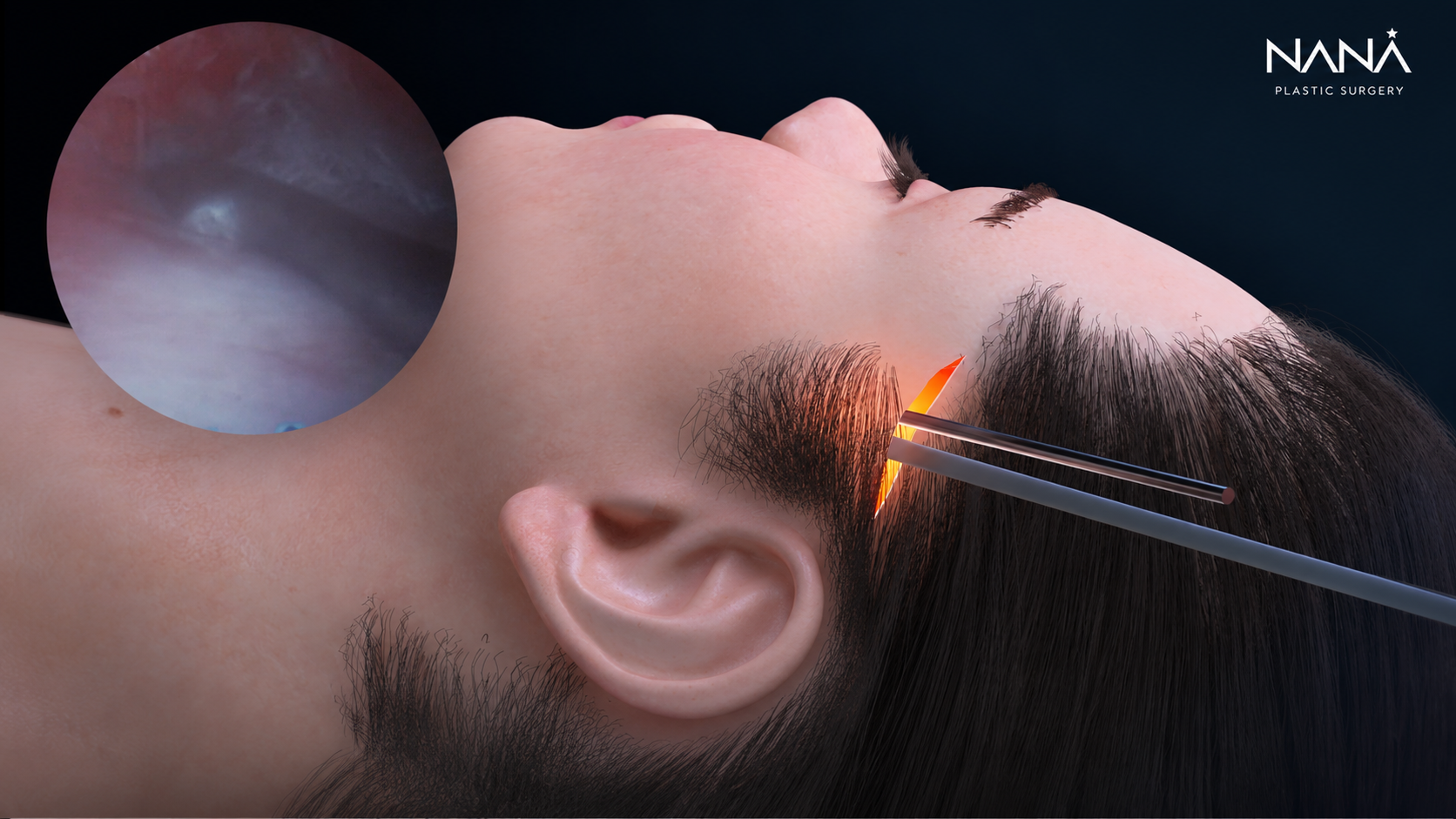
After the endoscope is inserted, the tissue is carefully dissected under direct visualization, allowing the retaining ligaments to be precisely released for effective lifting and repositioning.
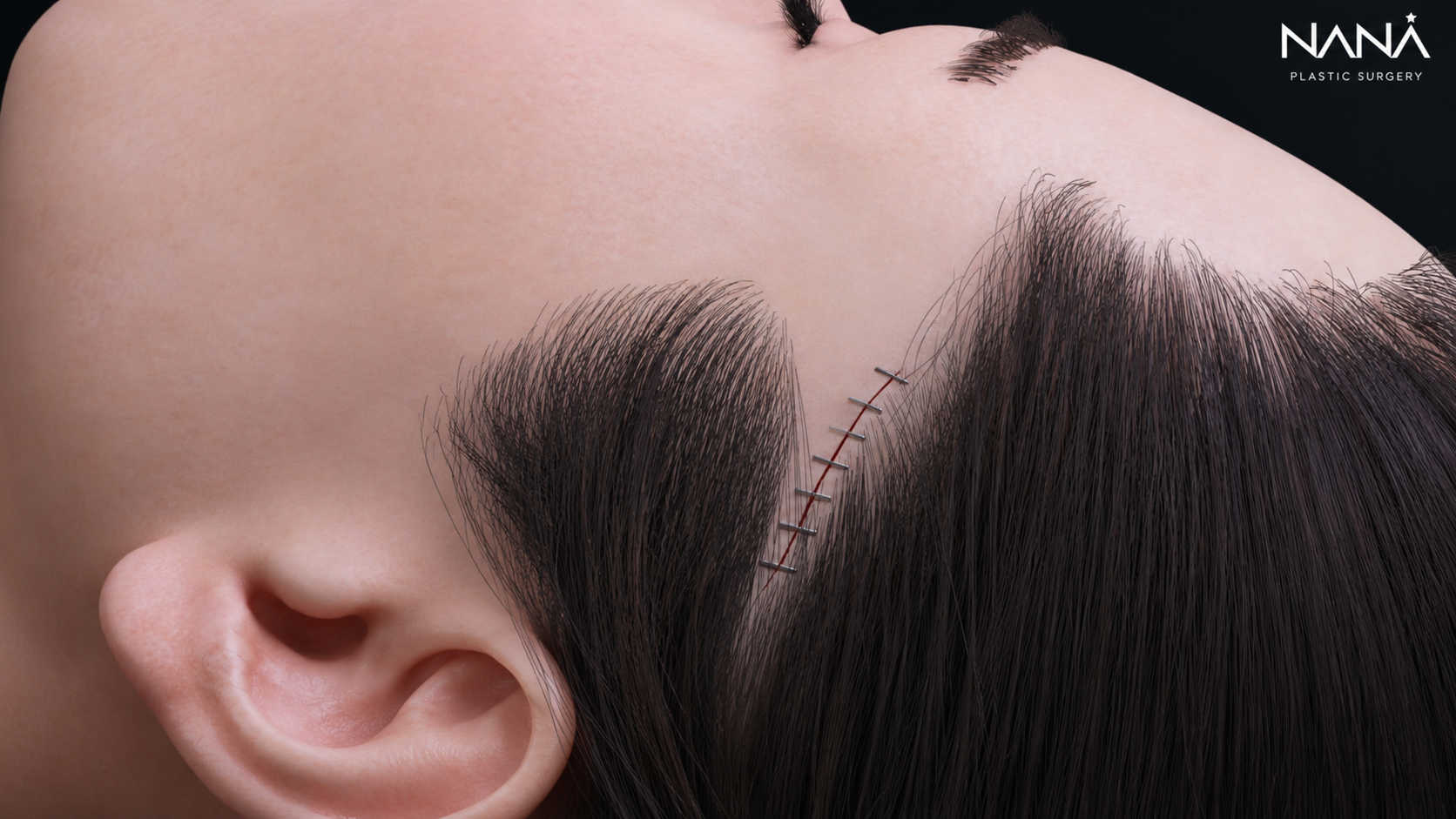
The lifting position is secured with double suture fixation, followed by careful closure and final staple fixation.
Not sure whether a Ponytail Lift or a full facelift fits your degree of sagging? Send us a front and side photo and our team will review it with the doctors, with no obligation.
The Surgical Method, Step by Step
- Design a precise surgical plan based on the degree of sagging, facial structure, skin condition, age, and aesthetic goals, through detailed consultation and examination.
- Make a small incision of approximately 3 cm inside the hairline near the temple area so the incision can be well hidden.
- Insert an endoscope to carefully access the deeper facial layers and identify the SMAS layer and retaining ligaments.
- Carefully separate the tissue beneath the SMAS layer and release the cheekbone retaining ligaments to allow a more effective upward lift.
- Lift and reposition the deeper facial tissues in a more vertical direction to improve the brows, outer eyes, cheeks, nasolabial folds, marionette lines, and early jawline laxity.
- Secure the lifted tissues in the ideal position and close the incision with careful suturing for stable healing.
What Recovery Looks Like
In the early recovery period, the face may feel and look slightly tight. This is expected: the retaining ligaments and deeper tissues have been lifted and repositioned, so the face is holding a new position it has not held before.
Results usually begin to look more natural as swelling improves and the tissues settle into place. Recovery speed varies from person to person, which is why the timeline given at your consultation is based on your own tissue condition rather than a fixed schedule.
Post-operative care at NANA is designed to support swelling management, healing, and patient comfort throughout that settling period. International patients travelling to Seoul should plan their return flight around the recovery guidance given by the surgical team rather than booking a fixed window in advance.
NANA's Lifting System in Seoul
Each surgery is planned around the individual's aging pattern rather than a fixed approach applied to every patient.
- Precise pre-operative analysis. Individual facial structure, skin laxity, tissue condition, and aging pattern are assessed before planning.
- Customized surgical planning. The plan is built around natural-looking anti-aging results for your face.
- Endoscopic deep-plane technique. Small, discreet incision placement with access to the deeper layers.
- Specialized medical team. Experienced in facial lifting and anti-aging surgery.
- Anesthesia and safety monitoring. A monitoring system supports a more stable surgical process.
- Post-operative recovery care. Designed to support swelling management, healing, and patient comfort.
Before & After
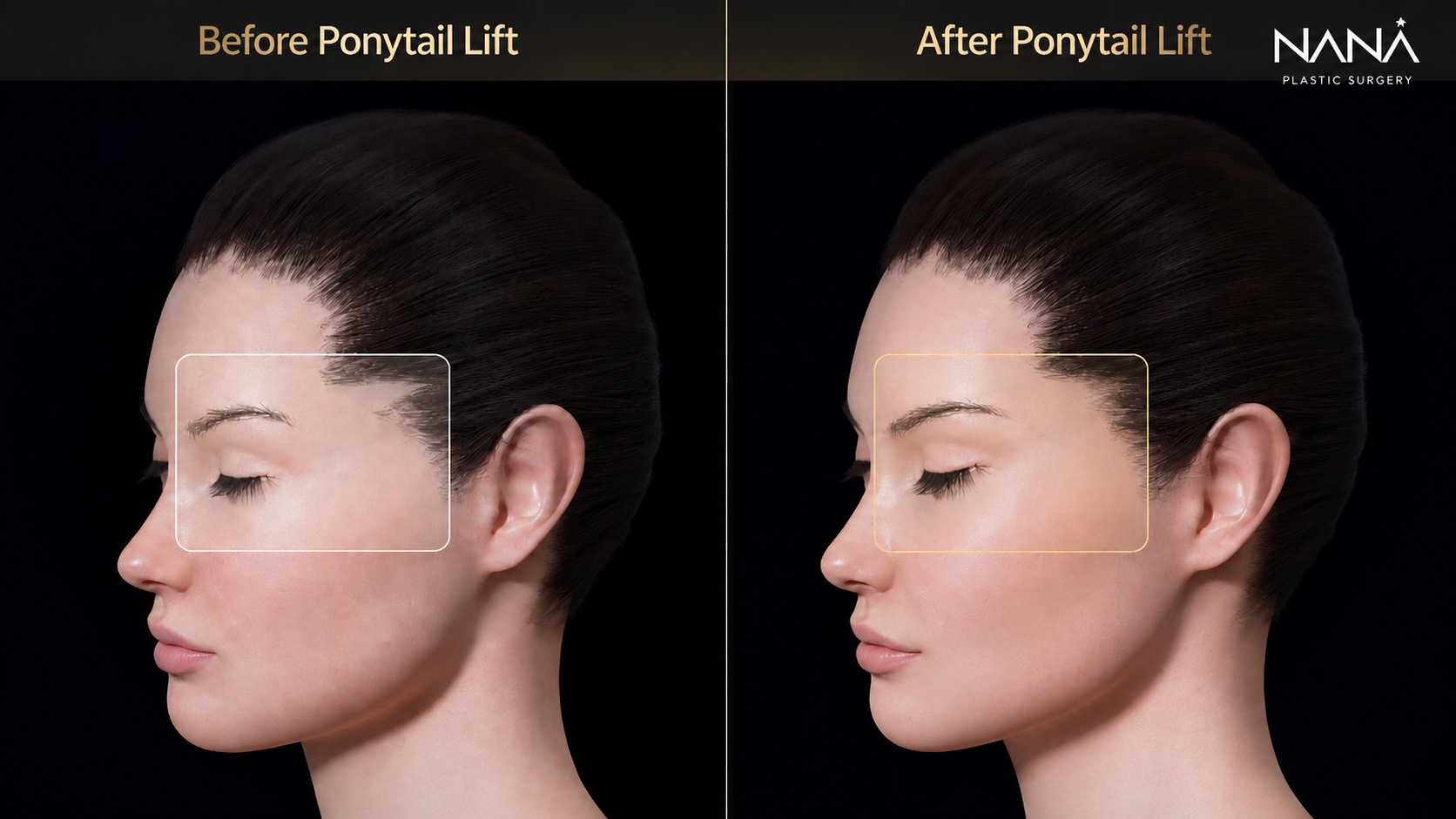
Individual results may vary.
Ideal Candidates for a Ponytail Lift
The Ponytail Lift works best when there is descent to reposition but not a large amount of skin to remove. It may be suitable for patients who notice the following.
- Mild to moderate facial sagging
- Brow or outer eye drooping
- Upper eyelid heaviness caused by tissue descent
- Sagging in the temples and cheeks
- Deepening nasolabial folds and early marionette lines
- Early blurring of the jawline
- Little excess skin, with a lifted look when gently pulling the face upward
- A preference for natural anti-aging results with hidden incisions, often in the 20s, 30s, or 40s
For mild to moderate sagging without significant excess skin, where repositioning the deeper tissues upward is enough to refresh the face.
Patients with severe skin laxity or a significantly sagging jawline may benefit more from a full facelift, where excess skin is removed. Our deep plane, mini, and micro facelift comparison breaks down the difference.
A consultation with a qualified medical professional is necessary to determine the most appropriate option for your anatomy. It is also worth understanding the risks common to facial lifting surgery before you decide.
The Care Around Your Surgery
Individual Pre-Operative Analysis
Facial structure, skin laxity, tissue condition, and aging pattern are assessed before the plan is set.
Anesthesiologist On-Site
A board-certified anesthesiologist is on-site for every procedure, with continuous monitoring.
Board-Certified Surgeons
All surgeons hold Korean Society of Plastic and Reconstructive Surgeons (KSPRS) board certification.
KHIDI-Registered
A foreign-patient receiving facility registered with KHIDI, with English medical records for international patients.
Frequently Asked Questions
What is a Ponytail Lift?
How is NANA's Ponytail Lift different?
Where is the incision made?
Is the Ponytail Lift the same as a thread lift?
Who is a good candidate for a Ponytail Lift?
Will the result look natural?
When will the results look natural?
Can I start a consultation online?
Medical Disclaimer: This article is for general informational purposes only and does not constitute medical advice. All surgical procedures carry risks, and suitability, technique, and recovery can only be determined through a personal consultation with a board-certified plastic surgeon at NANA Plastic Surgery.