
NANA BLOG
Which Facelift Technique Is Right for You
Contents
Deep Plane vs Mini vs Micro Facelift in Korea:
Which One Fits Your Face?
Three lifts, three depths. The right facelift depends on how far your face has descended, not the number on your birthday. Here is how Deep Plane, Mini, and Micro compare at NANA, and how to tell which one suits you.

A facelift is not one operation. Facial aging affects several layers at once, the skin, the fat compartments, the retaining ligaments, and the deeper SMAS layer, and everyone loosens and descends a little differently. That is why the technique matters more than age: it decides whether the result looks natural and balanced, or tight and pulled. At NANA, our facelift specialists focus on anti-aging facial surgery, and the plan is built around your facial structure rather than a fixed method applied to everyone. This guide compares the three lifts most international patients weigh when researching facelift surgery in Korea.
Key Takeaways
- Deep Plane, Mini, and Micro are three different lift depths. The right one depends on how much your face has descended, not your age alone.
- The Deep Plane Facelift releases the retaining ligaments and repositions the deep SMAS layer for the most complete, longest-lasting result, often more than ten years.
- The Mini Facelift is a mid-level SMAS lift through a short incision at the front of the ear, for the lower cheek and jawline, lasting about five to seven years.
- The Micro Facelift is the most minimal option, light SMAS support through a very small incision hidden in the ear crease, lasting about three to five years.
- Plan your stay around the recovery: roughly 10 to 14 days in Korea for a Deep Plane lift, 7 to 10 days for a Mini, and about 7 days for a Micro. A consultation is the only reliable way to match the technique to your face.
Deep Plane vs Mini vs Micro Facelift
A quick side-by-side before we look at each technique in detail.
| Deep Plane | Mini | Micro | |
|---|---|---|---|
| Lift depth | Deep tissue and SMAS layer | Mid-level SMAS lift | Superficial to light SMAS support |
| Best age | 40s to 60s and beyond | Mid 30s to 50s | 30s to early 40s |
| Focus areas | Midface, nasolabial folds, jowls, neck | Lower cheek, jawline, mild folds | Jawline edge, early laxity |
| Downtime | 2 to 3 weeks | 1 to 2 weeks | About 1 week |
| Longevity | 10+ years | 5 to 7 years | 3 to 5 years |
| Time in Korea | 10 to 14 days recommended | 7 to 10 days recommended | About 7 days recommended |
Deep Plane Facelift in Korea
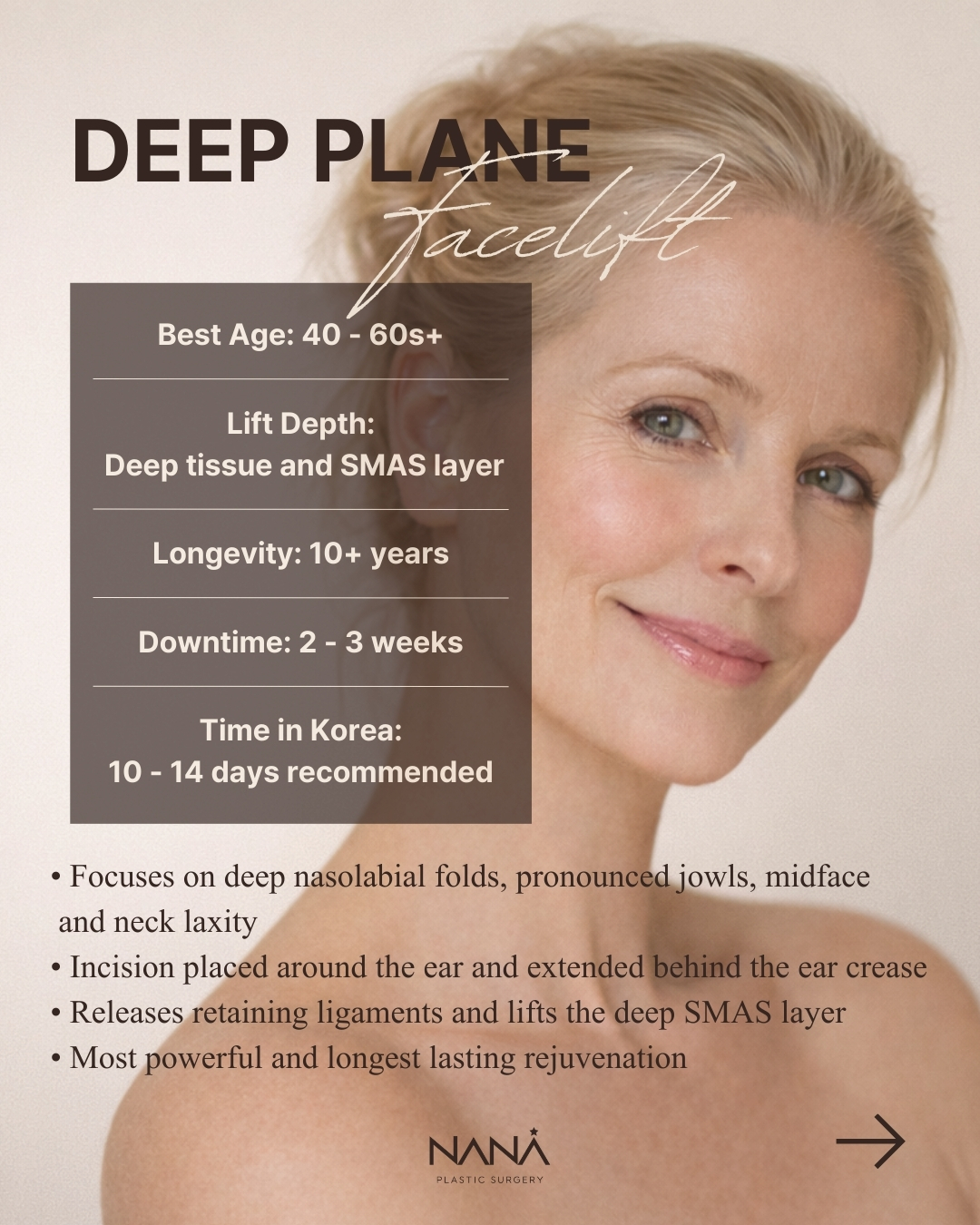
A Deep Plane Facelift is more than tightening loose skin. Instead of pulling only the surface, it lifts and repositions the deeper structural layers, releasing the facial retaining ligaments and elevating the SMAS layer together with the tissue above it as one unit.
Those retaining ligaments connect the skin and fat to the bone and hold each tissue in place. With age they loosen along with the SMAS, so the skin and fat drift downward. Releasing them beneath the SMAS is what makes the lift look natural and last, rather than tight or pulled. Because the correction happens at a structural level, the cheeks, jawline, and neck are lifted together while your natural expression is preserved.
Best suited to
- Midface descent and deep nasolabial folds
- Pronounced jowls and loss of jawline definition
- Neck laxity alongside lower-face sagging
- Moderate to advanced aging, typically the 40s to 60s and beyond
See the full technique, including how the SMAS layer and retaining ligaments are released, on the Facelift procedure page. When neck laxity is the main concern, the Neck Lift and Platysmaplasty can be part of the plan.
Mini Facelift in Korea
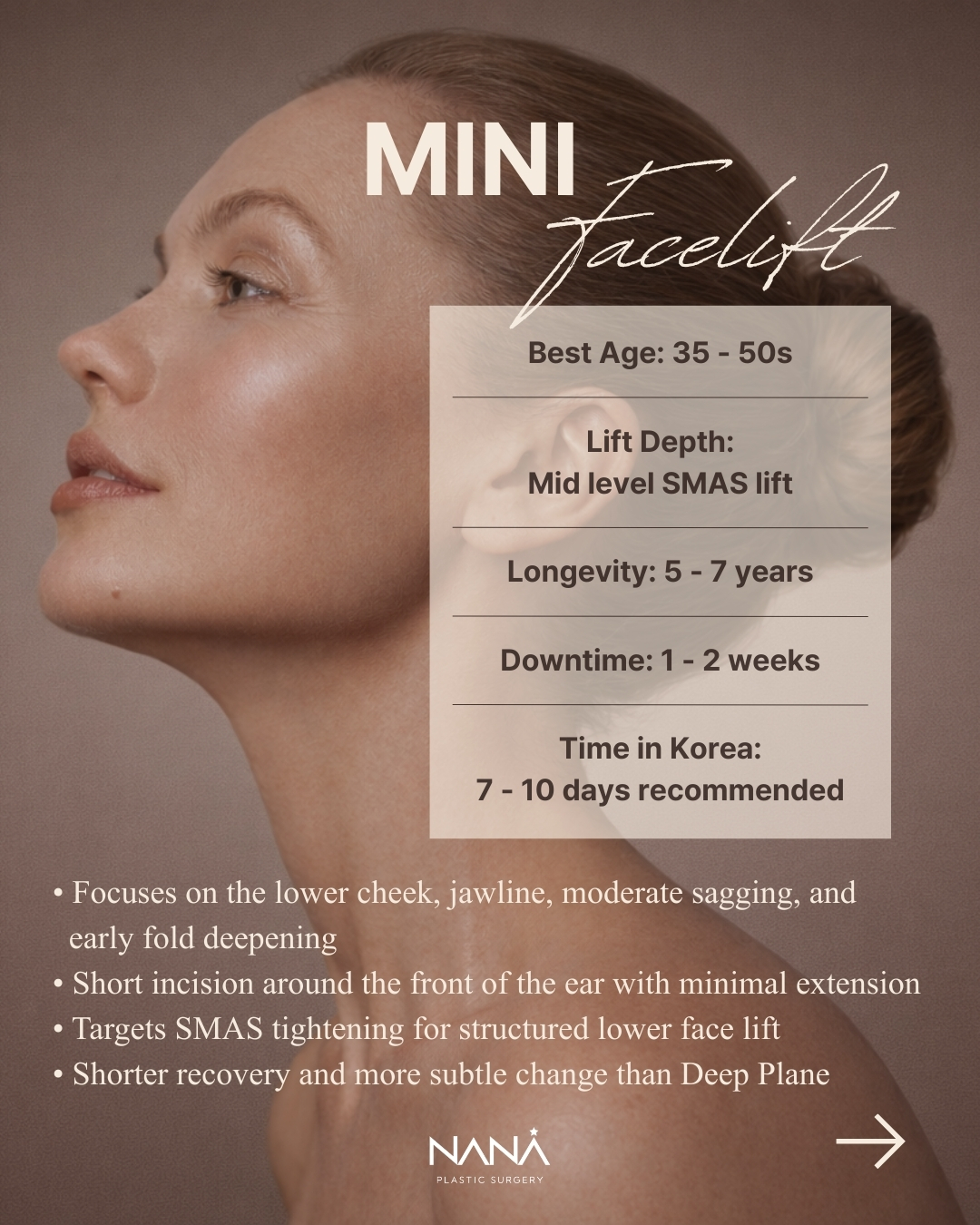
The Mini Facelift is a mid-level SMAS lift focused on the lower face. Rather than working only on the surface, it tightens the SMAS layer to lift the lower cheek and redefine the jawline, and it holds moderate sagging and early fold deepening far better than a skin-only approach.
It is performed through a short incision around the front of the ear with minimal extension, so the surgical burden is lighter and recovery is quicker than a Deep Plane lift. The change is real but more subtle, which is why it suits earlier, moderate laxity rather than advanced descent.
Best suited to
- Lower cheek and jawline sagging
- Moderate laxity and early fold deepening
- Anyone wanting a structured lower-face lift with a shorter recovery
- Typically the mid 30s to 50s
Read more about our targeted lift on the Mini Facelift I, II page.
Micro Facelift in Korea
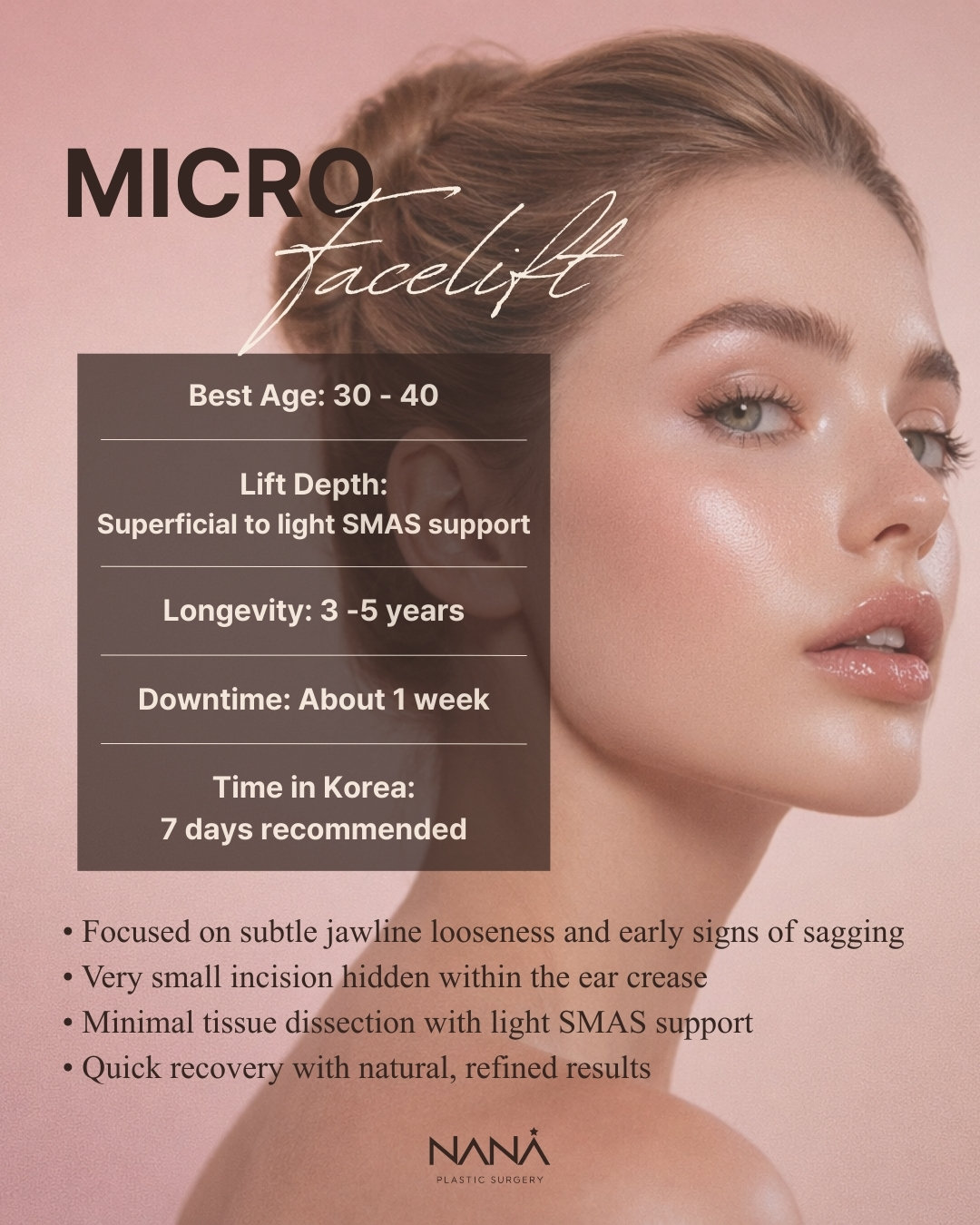
The Micro Facelift is the most minimal surgical option, giving superficial to light SMAS support for subtle jawline looseness and the earliest signs of sagging. It uses a very small incision hidden within the ear crease and minimal tissue dissection, so the scar stays discreet and recovery is quick.
Because the change is refined rather than dramatic, it is well suited to preventive rejuvenation, keeping the lower face looking fresh and natural before sagging becomes pronounced. Many patients choose it as a first step, with the option to consider a deeper lift later as aging progresses.
Best suited to
- Subtle jawline looseness and early signs of sagging
- Preventive rejuvenation before sagging becomes pronounced
- Anyone wanting a quick recovery with natural, refined results
- Typically the 30s to early 40s
Learn more on the Micro Facelift page. If you are not ready for surgery, a Thread Lift is a non-surgical option for very early laxity.
Not sure which lift suits you? Send us a clear front and side photo and our team will review it with the doctors, with no obligation.
Which Facelift Technique Is Right for You
Four things matter more than age when choosing a lift: the degree of tissue descent, your skin elasticity, how much the midface has changed, and how long you want the result to hold.
- Advanced structural sagging. A Deep Plane Facelift addresses the midface, jowls, and neck together for the most complete and longest-lasting rejuvenation.
- Moderate lower-face laxity. A Mini Facelift reinforces the fascia layer for a firm jawline and a defined V-line, with a lighter recovery.
- Early or preventive aging. A Micro Facelift refines subtle looseness through a small hidden incision, with the least downtime of the three.
At NANA Plastic Surgery in Seoul, we assess your skin aging, facial proportions, and degree of sagging in detail, then recommend the technique that gives the safest and most natural outcome for your face.
Explore Related Procedures
- Facelift · the full structural, deep-plane lift
- Mini Facelift I, II · the mid-level SMAS lower-face lift
- Micro Facelift · the minimal, light-SMAS lift
- Neck Lift and Platysmaplasty · for neck laxity and bands
- Forehead Lift · for the brow and upper face
- Thread Lift · a non-surgical option for very early laxity
The Care Around Your Surgery
Anti-Aging Focused Team
Our surgeons concentrate on facial anti-aging surgery, offering both SMAS and deep plane techniques for natural, lasting results.
Anesthesiologist On-Site
A board-certified anesthesiologist is on-site for every procedure, with continuous monitoring.
Board-Certified Surgeons
All surgeons hold Korean Society of Plastic and Reconstructive Surgeons (KSPRS) board certification.
KHIDI-Registered
A foreign-patient receiving facility registered with KHIDI, with English medical records for international patients.
Frequently Asked Questions
What is the difference between a deep plane, mini, and micro facelift?
How is a deep plane facelift different from a traditional facelift?
How long do facelift results last?
Is a mini facelift better than a thread lift?
How long should I stay in Korea for a facelift?
Which facelift has the smallest scar and the least downtime?
How do I know which facelift is right for me?
Medical Disclaimer: This article is for general informational purposes only and does not constitute medical advice. All surgical procedures carry risks, and suitability, technique, recovery, and expected results can only be determined through a personal consultation with a board-certified plastic surgeon at NANA Plastic Surgery.