
NANA BLOG
Forehead Reduction in Korea: Lowering a High Hairline at NANA
Contents
Forehead Reduction in Korea: Lowering a High Hairline at NANA
A broad forehead with a high hairline is brought into proportion with the rest of the face by shifting the hairline downward, with the hair follicles preserved so scarring stays minimal.
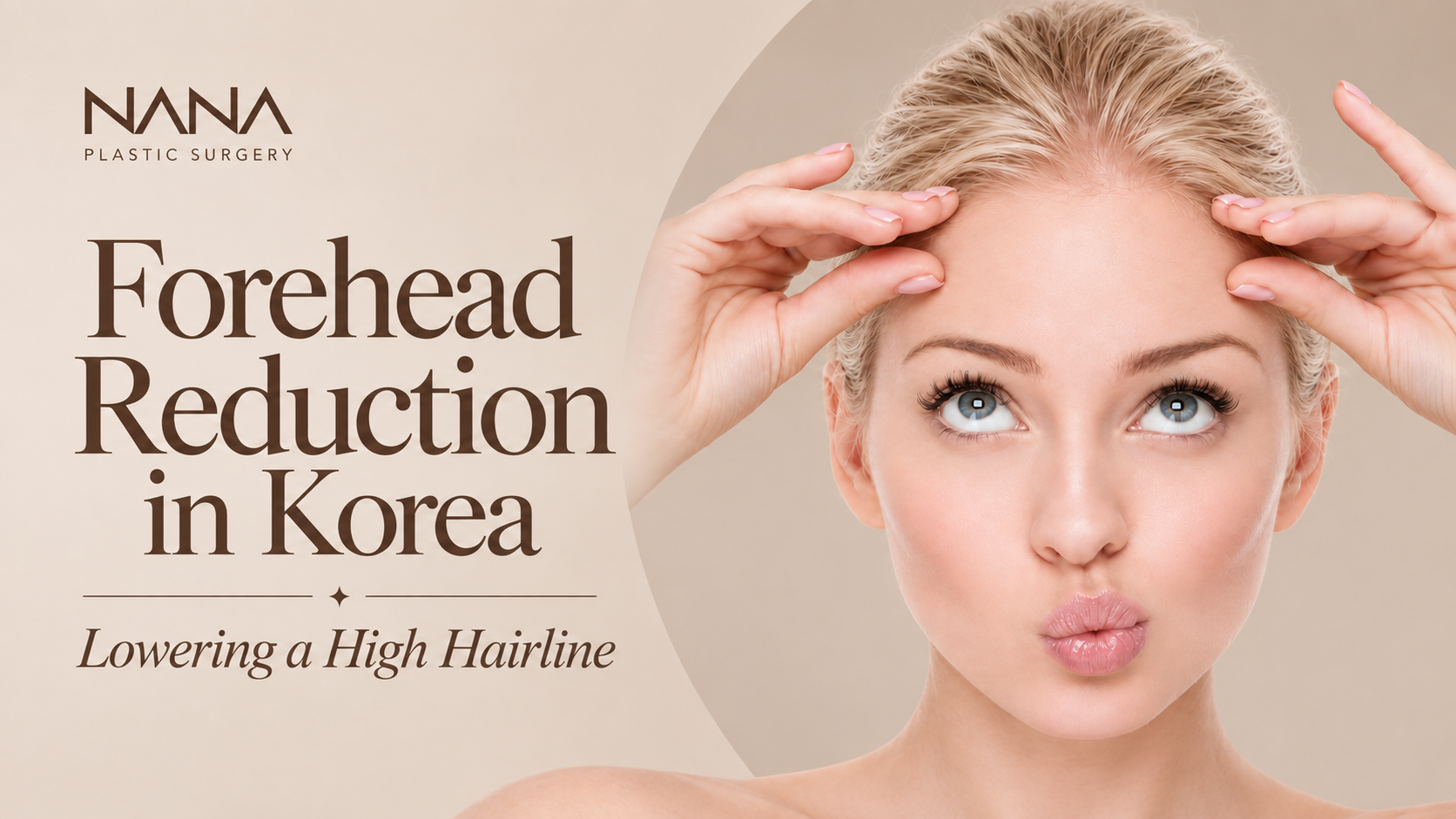
A forehead that reads as too wide or too tall changes the balance of the whole face, and it is not something a haircut can fix for long. Forehead reduction surgery in Korea, also known as hairline lowering surgery, addresses it directly. The hairline area is incised, then the scalp is pulled and secured to reduce the length of the forehead, adjusting a broad forehead so that it aligns with facial proportions while the hair follicles are preserved to keep scarring minimal.
Key Takeaways
- The surgery shifts the hairline downward to an ideal forehead height, so a face that looked elongated appears smaller.
- Unlike hair transplantation, results are immediate.
- A diagonal incision protects the supraorbital nerve and limits damage to hair follicles, and vellus hair on the forehead is retained for a natural hairline.
- Endotine, an FDA and KFDA approved fixation material, secures the hairline, and triple stitching minimizes scarring.
- Surgery takes about 1 hour under general anesthesia, with no hospital stay, sutures out after 9 to 10 days, and a return to daily life after 1 week.
What Is Forehead Reduction Surgery (Hairline Lowering)?
The forehead reduction procedure at NANA addresses cases where the forehead is broad with a high hairline. By shifting the hairline downward, it brings the forehead to an ideal height. Unlike hair transplantation, the results are immediate, and a face that previously looked elongated appears smaller.
How Is the Hairline Lowered and Corrected in Forehead Reduction?
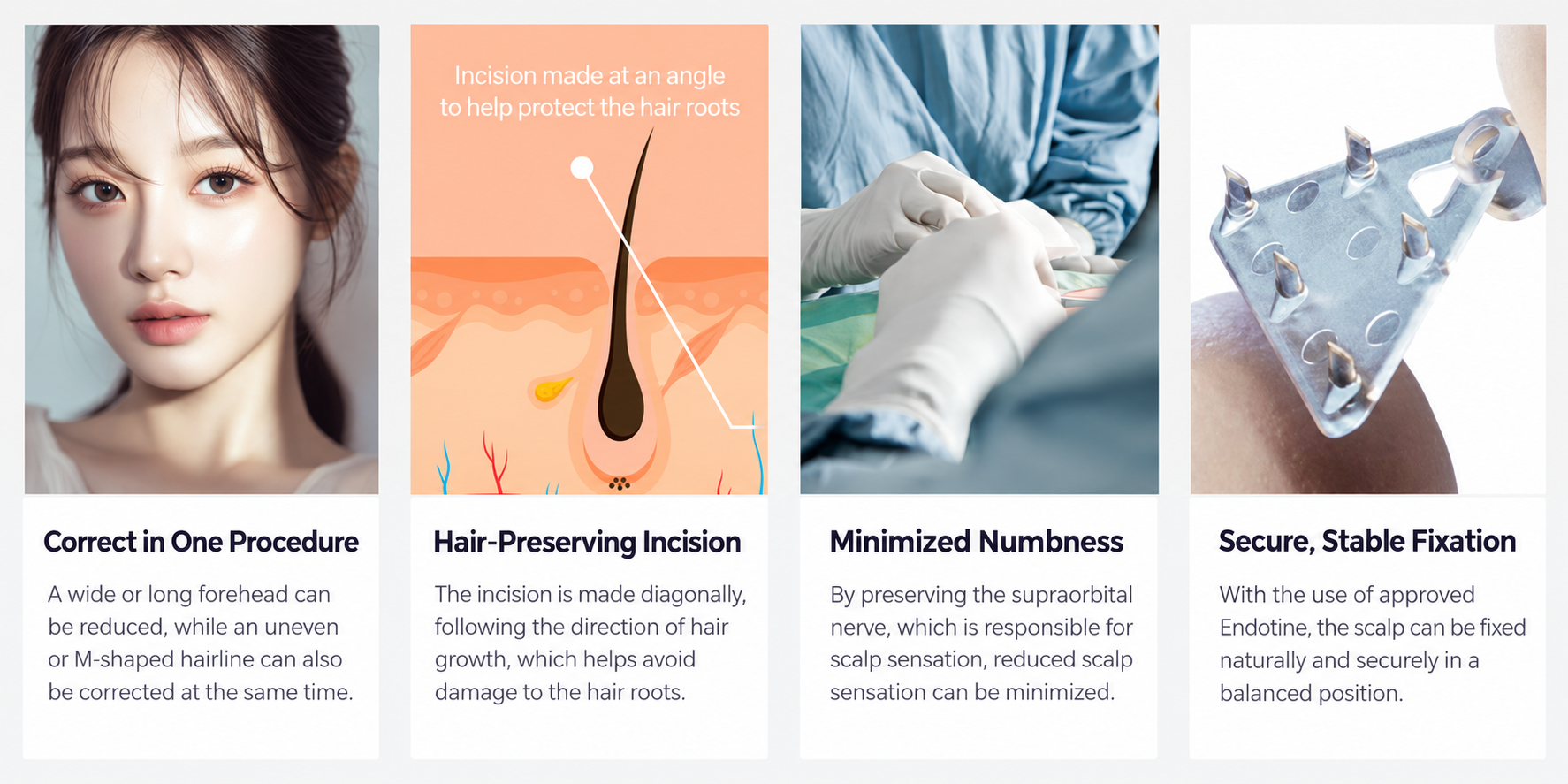
- Hairline adjustment: lowering the hairline to the appropriate position to achieve forehead reduction.
- Correction of angular lines: not only reducing the forehead but also correcting angular hairlines into a more even and rounded shape.
Preserving Hair and Vellus Hair at the Temporal Line
Because the incision is made at an angle, there is minimal damage to the hair follicles and surgical traces stay discreet. The fine vellus hair on the forehead is also strategically retained, which is what makes the new hairline read as natural rather than drawn on.
What Is Endotine, and Why Is It Used?
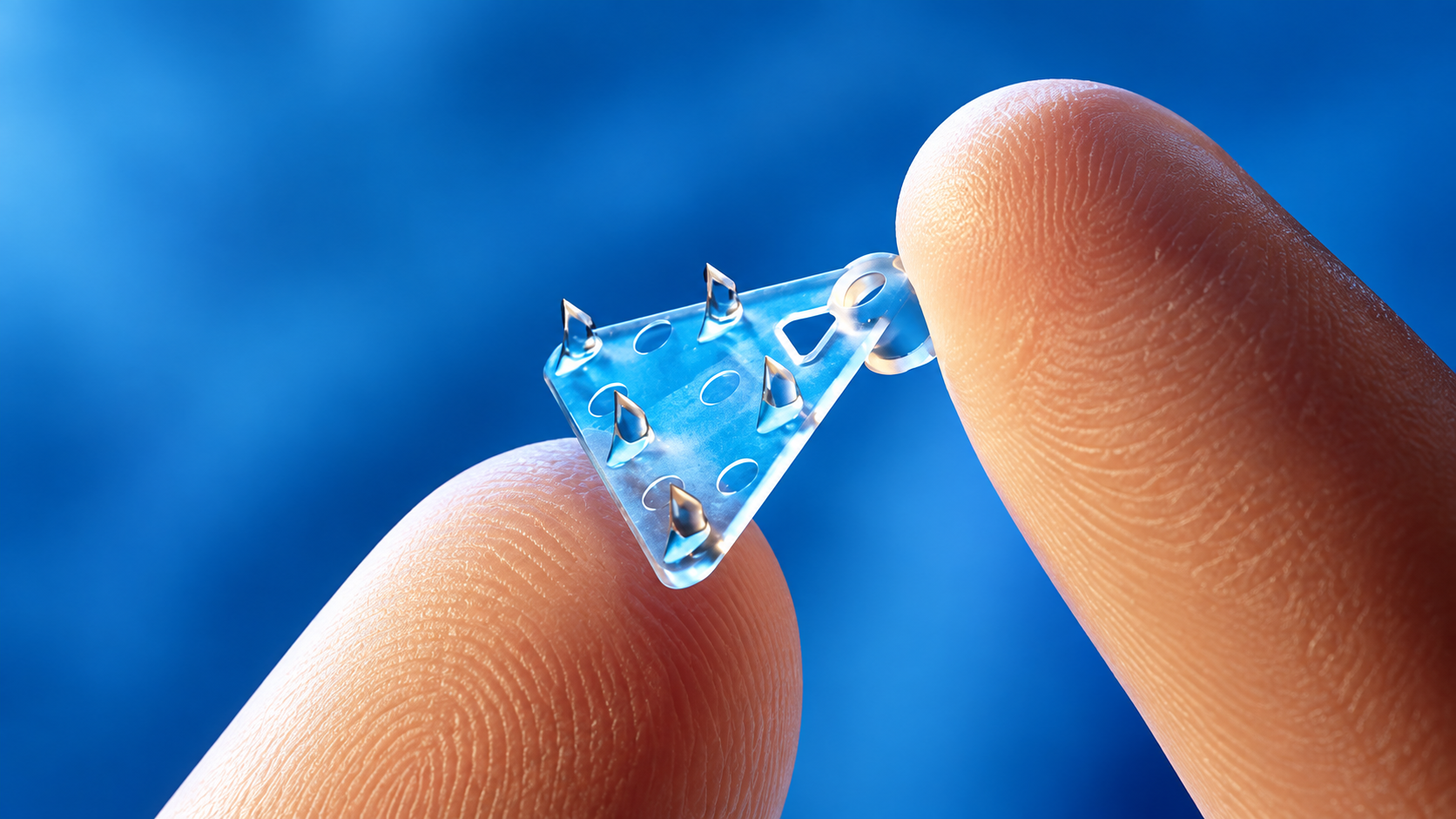
Endotine provides stability in several facial areas, including the forehead, the eyebrows, and sagging eyelids. It is also used in NANA's endoscopic forehead and brow lift, which is a separate procedure. As it dissolves it leaves no residue behind, and it gives the skin a semi-permanent elasticity.
- Sturdy Endotine: a robust Endotine with low skin tension holds the hairline securely, for a safe and stable outcome in forehead reduction surgery.
- Triple stitching solution: triple stitching minimizes scarring, so recovery is swift and patients see the benefit of the procedure sooner.
How Is the New Forehead Height Decided?
Rather than lowering the hairline by a fixed amount, the height is set so the upper third of the face sits in balance with the middle and lower thirds. This is why the same procedure produces a different design on every patient.
How Is Forehead Reduction Surgery Performed at NANA in Seoul?
| Stage | What happens |
|---|---|
| 01 Design | A thorough consultation is conducted before surgery. The exact positions for the incisions and the desired corrected line are meticulously designed based on individual considerations. |
| 02 Incision | To safeguard the supraorbital nerve and minimize damage to hair follicles, the incision site is angled diagonally. This prioritizes the preservation of critical structures for a safer and more effective outcome. |
| 03 Fixation | Endotine, a secure fixation material, is strategically placed in the forehead to anchor it, gently pulling the forehead toward it for stable and secure fixation. |
| 04 Closure | To conceal any visible scars, the incision site is meticulously closed, leaving no trace of a noticeable scar. The careful stitching and closure process contributes to a clean finish. |
Wondering how much your hairline could come down? Send us your photos from the front, 45 degrees, and side, and our English-speaking team will review them with the doctors.
Who Is a Candidate for Forehead Reduction Surgery?
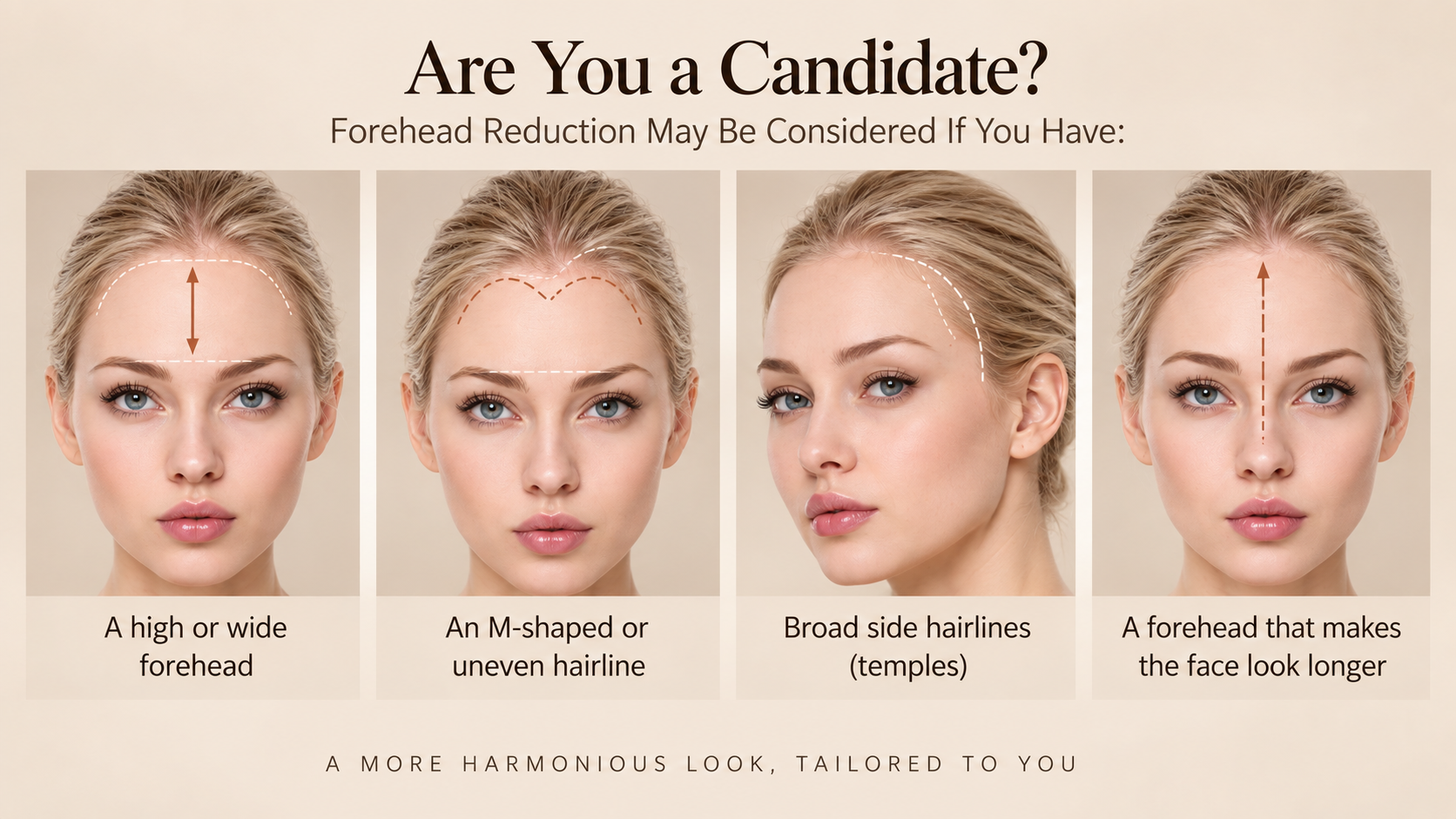
These are the cases the procedure is designed for, all of them united by one aim: a natural line that complements the shape of your face.
- Your hairline forms an M-shape or is asymmetrical
- Your forehead is excessively wide or large
- The side of your hairline is broad
- A wide forehead makes your face appear longer
- You find contour surgery burdensome
- You are apprehensive about hair transplantation, or did not achieve the results you wanted after it
How Long Does Forehead Reduction Surgery Take, and Is a Hospital Stay Needed?
| Item | Details |
|---|---|
| Surgical time | Approximately 1 hour |
| Anesthesia method | General anesthesia |
| Hospitalization | None |
| Drain | None |
| Suture removal | After 9 to 10 days |
| Return to daily life | Possible after 1 week |
| Outpatient treatment | 1 week after surgery |
What Makes Forehead Reduction at NANA Plastic Surgery Different
NANA strives to embody beauty through a comprehensive approach, using a variety of methods and technologies. The most suitable surgical method is selected after considering individual factors such as bone structure, connective tissue, and skin type.
Hairline-Preserving Incision
An incision that considers the direction of hair growth, to minimize damage to the hair follicles.
Minimizing Sensory Impairment
Preserving the supraorbital nerve minimizes sensory impairment of the scalp.
Stable Fixation With Endotine
Certified Endotine is used to ensure a natural and balanced fixation of the scalp.
Simultaneous Correction
Correcting not only a wide and long forehead but also an uneven or M-shaped hairline.
What Is Recovery Like After Forehead Reduction Surgery in Korea?
| Timing | What to expect |
|---|---|
| Immediately after | Daily activities can be resumed, adopting a hairstyle that covers the forehead. |
| 1 to 2 weeks | Some swelling may remain in the central forehead area. |
| Days 9 to 10 | Sutures are removed. |
| 1 week | Return to daily life, and one outpatient visit. |
| First month | Initial scarring is noticeable. |
| 3 to 6 months | The scar tends to fade in color. |
Frequently Asked Questions
What is forehead reduction surgery?
How is forehead reduction different from a hair transplant?
What is Endotine?
Will forehead reduction leave a visible scar?
How much swelling can be expected after the surgery?
How long does the surgery take, and is a hospital stay needed?
When are the sutures removed and when can I return to daily life?
Can an M-shaped or asymmetrical hairline be corrected at the same time?
Will the surgery affect the sensation in my scalp?
Who is forehead reduction surgery suitable for?
If a high hairline or a wide forehead is what throws your proportions off, a personal consultation is where the new hairline position and shape are decided. Our English-speaking team can review your photos with the doctors before you travel. You can read more on the forehead reduction page or browse other posts on the NANA blog. Individual results vary.
WhatsApp: +82 10 9470-0591 · Instagram: @nanahospital_eng
Medical Disclaimer: This article is for general informational purposes only and does not constitute medical advice. All surgical procedures carry risks, and suitability can only be determined through a personal consultation with a board-certified plastic surgeon at NANA Plastic Surgery. Individual results vary.