
NANA BLOG
NANA's Endoscopic Preservé Breast Augmentation Less Pain, Faster Recovery
Contents
NANA's Endoscopic Preservé Breast Augmentation
Less Pain, Faster Recovery
Tissue preservation, reduced pain, and a fast return to daily life. Instead of dividing muscle to make room for the implant, NANA Endoscopic Preservé finds the natural space that is already in your body and places the implant there.
Ask around before breast augmentation in Korea and the same five questions come up. Does it really hurt that much? Is the pain on the day just luck of the draw? When can I go back to work? General anesthesia frightens me. Can I wash my hair right after surgery?
Every one of those questions is about the same three things: pain, the burden of recovery, and anesthesia. They are not questions about the implant. They are questions about what the surgery does to the body on the way to placing it, and that is a matter of surgical method rather than product choice.
NANA Endoscopic Preservé is the clinic's answer to those three concerns. It is a premium breast augmentation designed with fast recovery in mind, built on three ideas: preserve the tissue, reduce the pain, and get you back to daily life sooner.
Key Takeaways
- Endoscopic Preservé is a tissue-preserving breast augmentation that uses NANA's own specialized endoscope to find the Naturé Plane, the natural space already present in the body, and position the implant there.
- Pain comes largely from irritation of muscle and tissue, so dissection follows that natural layer and secures only the space that is needed.
- You choose the incision site: armpit or inframammary fold. Conventional tissue-preserving methods allow the fold only.
- There is no restriction on implant brand or size, and both sleep sedation and local anesthesia are possible.
- There is no separate disposable kit device cost.
- Motiva, Mentor Extra, Mentor Boost, and Bouns can all be used, matched to your body.
What Is Tissue-Preserving Breast Augmentation?
Every breast augmentation needs somewhere for the implant to sit. The conventional answer is to make that somewhere, by dividing muscle and dissecting tissue until a pocket exists. The tissue-preserving answer is different: the space is not created, it is found.
The Naturé Plane
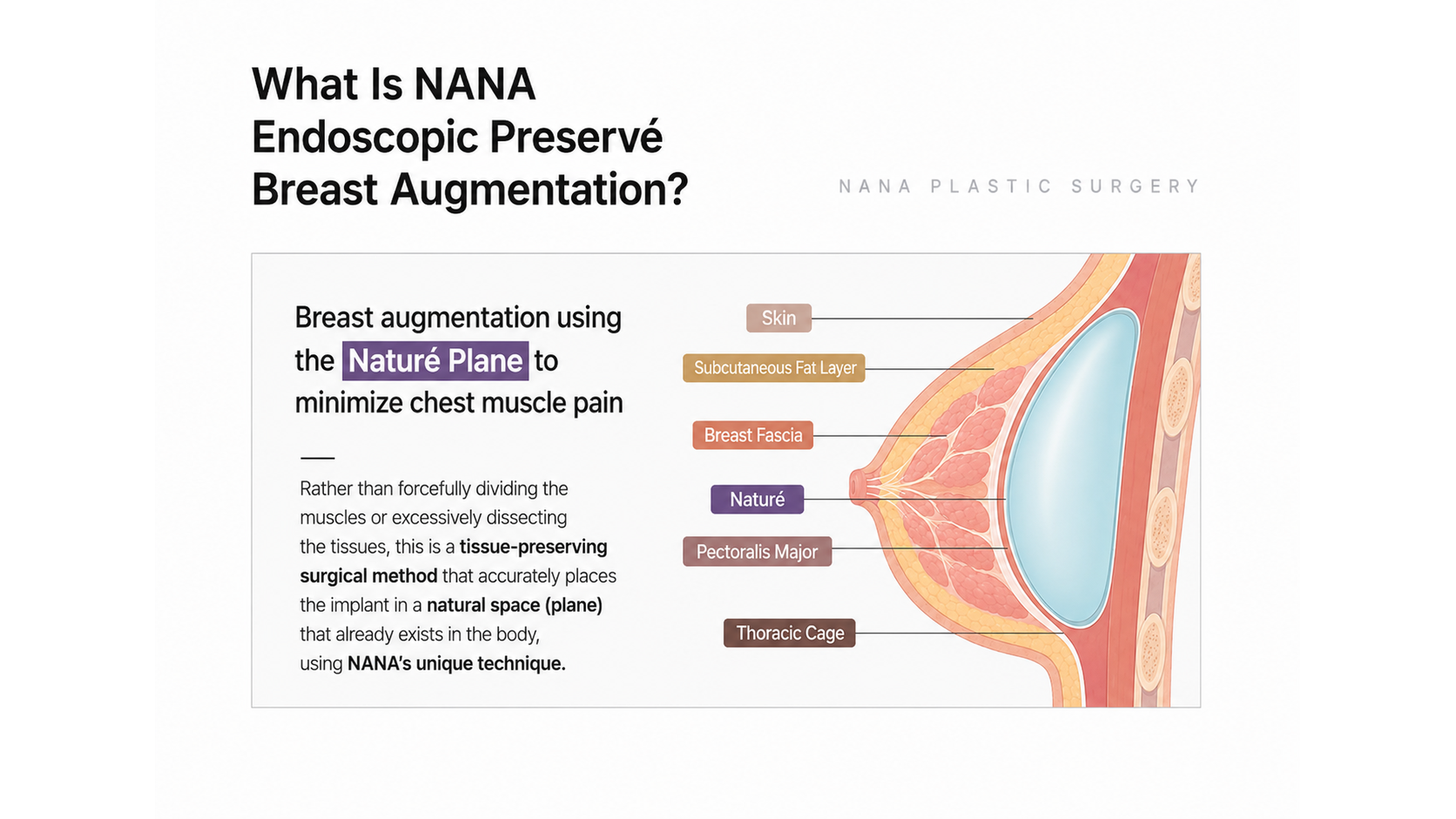
NANA Endoscopic Preservé is breast augmentation that uses the Naturé Plane to minimize chest muscle pain. Rather than forcibly dividing the muscle or dissecting tissue excessively, the surgical team uses NANA's own specialized endoscope to locate precisely the natural space, the Plane, that already exists in your body, and to position the implant there. That is what makes it a tissue-preserving surgical method rather than a tissue-dividing one.
The layers involved
Reading outward from the chest wall, the structures are the rib cage, then the pectoralis major, then the Naturé Plane, then the breast fascia, the subcutaneous fat layer, and finally the skin. The Plane is a natural layer within that sequence. Knowing exactly where it lies in your particular anatomy, and reaching it without disturbing what sits above and below it, is the whole point of using the endoscope.
Why Does the Pain Burden Go Down?
The core of pain is irritation of muscle and tissue. That single fact is what the whole design follows from. If pain tracks tissue irritation, then reducing pain is a question of how much tissue the surgery has to irritate, and the Naturé Plane is what allows that amount to be kept low.
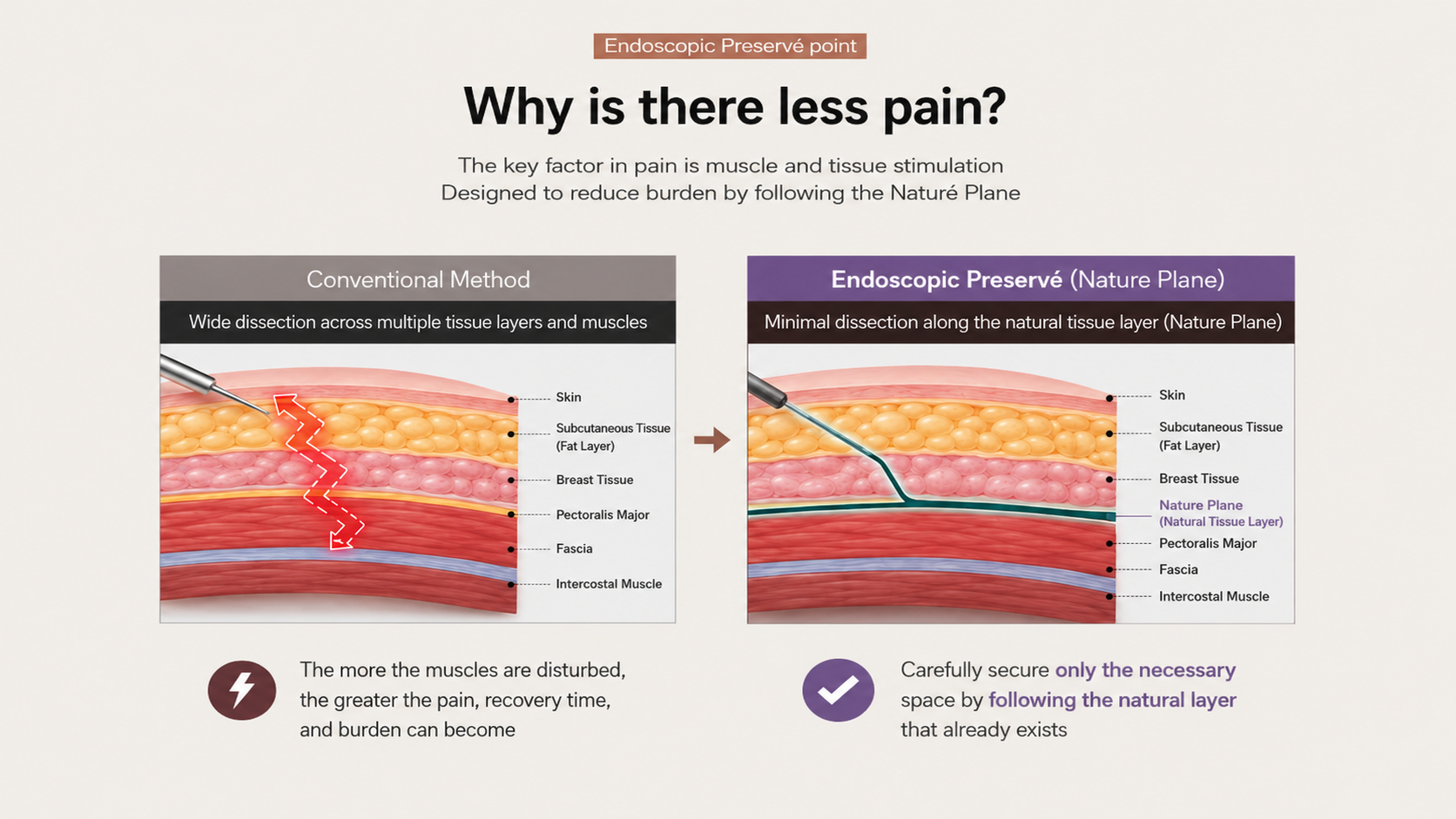
Wide dissection across layers and muscle
The path crosses skin, subcutaneous fat, glandular tissue, the pectoralis major, the fascia, and the intercostal muscle. The more the muscle is disturbed along the way, the more pain, recovery time, and general burden can increase.
Minimal dissection along the natural layer
The approach follows the Naturé Plane, the layer that already exists, and secures only the space that is actually needed, delicately rather than broadly.
This is also the answer to the question about the day of surgery being unpredictable. Pain that comes from how much muscle was disturbed is not random. It follows the method.
Wondering whether the tissue-preserving approach suits your body type and your schedule? Our breast team can review your situation with the specialists, with no obligation.
Who Is Endoscopic Preservé Suited To?
- Those who are worried about the burden of pain
- Those who want to lower the burden of a breast surgery scar
- Those who hope for a relatively fast return to daily life after surgery
- Those thinking carefully about a first breast surgery
- Those who want a natural feel and a beautiful line
Four things support that list in practice, and they run from the first consultation through to the weeks after you go home.
Premium consultation
A customized plan that takes body type, skin thickness, and the glandular tissue and rib cage into account.
Breadth of implant choice
Compare Motiva, Mentor, Bouns, and other implants directly, and select the product that fits you.
Safety system
An anesthesiology and pain medicine specialist on site, with a systematic surgical and safety management protocol.
Aftercare
Premium care matched to the stage of recovery, including hyperbaric oxygen and Capsulatis.
How Does It Differ From Conventional Tissue-Preserving Surgery?
Tissue-preserving breast augmentation is not new in itself. What has historically come with it is a set of restrictions, and those restrictions are where Endoscopic Preservé parts company with the conventional version. The surgical design is not confined to a particular implant or a particular incision method, so the range of choice can be matched to your body type and the result you want.
| Conventional tissue-preserving method (Motiva Preservé) | NANA's Endoscopic Preservé | |
|---|---|---|
| Incision site | Inframammary fold only | Armpit or inframammary fold, whichever you prefer |
| Surgical method | Blind dissection of the space | Precise dissection with a self-developed endoscopic instrument |
| Implant | A specific brand of implant | No brand restriction, all implants can be used |
| Size | Up to a C cup only | No size restriction |
| Anesthesia | Sleep sedation or local anesthesia | Both sleep sedation and local anesthesia possible |
| Cost | Implant plus a separate kit device cost | No additional kit device cost |
Choice of incision
Where the scar sits is one of the most personal decisions in breast surgery, and the conventional tissue-preserving method makes it for you by allowing the inframammary fold alone. Here you choose between the armpit and the fold.
Seeing rather than feeling
The conventional approach dissects the space blind. Endoscopic Preservé uses an endoscopic instrument developed in-house to dissect precisely, which is what makes it possible to follow a natural tissue layer rather than work through it.
No brand or size ceiling
Being locked to a specific brand of implant, and to a volume no larger than a C cup, are two limitations that rule the conventional method out for many people before the consultation even starts. Neither restriction applies here.
Anesthesia on your terms
Both sleep sedation and local anesthesia are possible, so the anesthesia conversation is a real choice rather than a fixed condition of the method.
No disposable kit charge
Conventional tissue-preserving surgery bills the kit device separately, on top of the implant. Without the burden of an unnecessary disposable kit, the surgery stays reasonable as well as precise.
Which Implants Can Be Used?
Implant selection is applied to you individually according to body type, rib cage width, skin thickness, the volume you want, and your preference for feel. Because there is no brand restriction, the conversation can start from your body rather than from a product the method obliges you to accept.
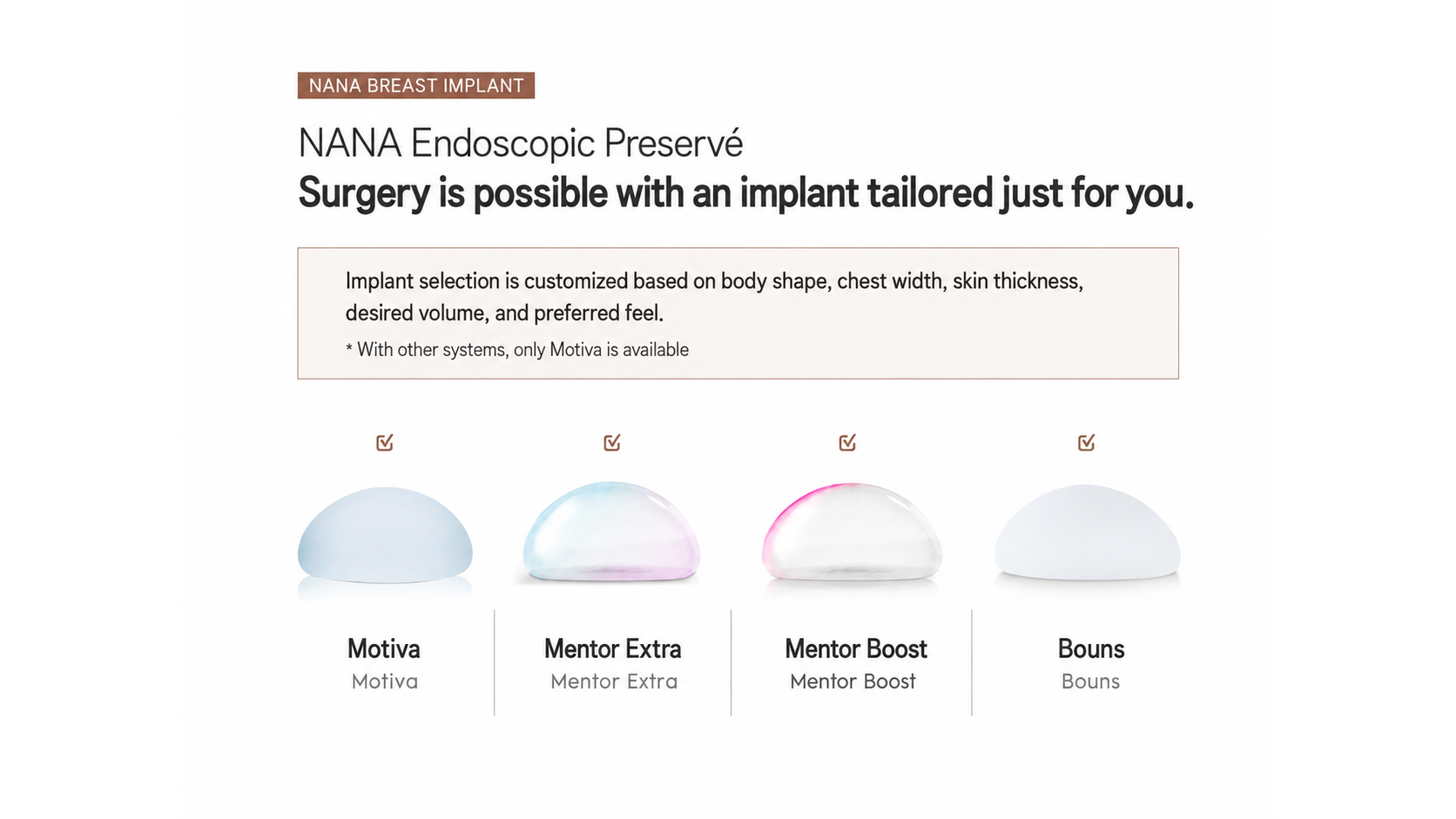
- Motiva
- Mentor Extra
- Mentor Boost
- Bouns
With other companies' systems, only Motiva can be used. Endoscopic Preservé carries no such restriction.
For a fuller comparison of implant types by body type, see our guide on choosing the right breast implant.
From Consultation to Recovery
- Detailed consultation. Rib cage width, skin thickness, and the breast pocket are checked, along with your existing volume and the degree of sagging.
- Implant comparison. Motiva, Mentor, Bouns, and others are compared, with a customized proposal for feel, size, and line.
- Surgical plan design. After the Naturé Plane is confirmed, the space is planned in the tissue-preserving direction.
- Recovery care. You are connected to premium aftercare including hyperbaric oxygen and Capsulatis.
The third step is the one that distinguishes this process from a standard augmentation pathway. The Naturé Plane is confirmed for your anatomy specifically before the surgical plan is drawn, rather than a pocket being planned and the anatomy worked around afterwards.
The Breast Screening System
Is all breast screening the same? Screening for an implant, and screening because of an implant, are different things. NANA finds not only the state of the breast but problems with the implant and with the capsule accurately, going beyond plastic surgery that emphasizes shape and feel alone. Plastic surgery, the breast disease division, and general surgery specialists work together so that breast screening is checked continuously and regularly, and the clinic accompanies you from the pre-surgical plan through to aftercare.
Why ultrasound before and after surgery
- Before surgery. The current state of the breast, including the overall contour and whether there is asymmetry, can be confirmed accurately, which helps decide the appropriate surgical method and implant.
- After surgery. Whether the implant has settled properly, whether there is rupture, and whether seroma has collected can all be checked.
Why NANA for Breast Surgery
NANA Plastic Surgery has performed 15,688 breast implant placements, on figures compiled by Korea's Ministry of Food and Drug Safety for 2020 to 2025. That volume of clinical experience and data is what shapes each individual breast. Objective facts are presented in accordance with Article 56 of the Medical Service Act.
Consultation and surgical volume
19,436 consultation requests as of June 2026 on the Gangnam Unni app, and 15,688 implant placements on MFDS statistics for 2020 to 2025.
An average rating of 9.8
The average score across 5,320 breast surgery reviews on the Gangnam Unni app.
A breast center at university hospital level
Up-to-date medical equipment systems for endoscopy, anesthesia, and care, with dedicated specialists in each field working together.
An academically active breast team
Active participation in domestic and overseas seminars, with continuous academic exchange and shared clinical experience.
Frequently Asked Questions
What is the biggest difference between conventional breast augmentation and Endoscopic Preservé?
Does breast augmentation pain really decrease with the endoscopic approach?
What is the Naturé Plane?
Where is the incision placed?
Conventional preserve methods were said to be difficult above a C cup. Is a larger size possible?
Which implants can be used?
What type of anesthesia is used?
Is there an extra device or kit cost?
Do I have to wear a compression bra?
What aftercare follows the surgery?
Why is breast ultrasound recommended both before and after surgery?
Medical Disclaimer: This article is for general informational purposes only and does not constitute medical advice. Complications such as bleeding, infection, and inflammation can occur after surgery, and subjective satisfaction can vary from person to person. Suitability, technique, recovery, and expected results can only be determined through a personal consultation with a board-certified plastic surgeon at NANA Plastic Surgery.