
NANA BLOG
Chin Augmentation vs Reduction: Which Genioplasty is Right for You?
Contents
Chin Augmentation vs Reduction Surgery in Korea:
Which Genioplasty Is Right for You?
Everything you need to know about chin surgery at NANA, from procedures to recovery.
Chin surgery, also called genioplasty, reshapes the chin bone or adds volume to the chin to bring the lower face into balance. The result is permanent. At NANA Plastic Surgery in Seoul, three main procedures are offered: weak or short chin surgery if the chin sits too far back, chin tip augmentation if it looks flat or undefined, and long or protruding jaw surgery if it projects forward.
Surgical time ranges from approximately 30 minutes for chin tip augmentation to about an hour and a half for weak chin correction. Most patients return to daily life within three to five days, while chin tip augmentation typically requires one to two weeks. All three are performed under sleep anesthesia.
Key Takeaways
- Genioplasty reshapes or adds volume to the chin to balance the lower face.
- Three procedures: weak chin surgery, chin tip augmentation, and long jaw surgery.
- All deliver permanent results under sleep anesthesia.
- Return to daily life: 3–5 days for bone surgery, 1–2 weeks for chin tip augmentation.
- Often combined with rhinoplasty for a transformed side profile.
Your Chin Shapes How the Rest of Your Face Looks
The chin has a significant influence on how the rest of the face is perceived, often more than patients expect. A chin that is too short can make the lips appear to project forward. One that is too long can give the face a pointed appearance. When the chin lacks definition, the jawline tends to disappear into the neck.
That is where genioplasty comes in. The procedure reshapes or adds volume to the chin to bring the lower face back into balance. At NANA Plastic Surgery, every procedure begins with a proper consultation and a 3D CT scan, so the surgical plan is built around your actual bone structure rather than a template. Korea has become one of the leading destinations for facial contouring work — patients searching for korea plastic surgery consistently find Seoul at the top, with chin surgery among the most-requested procedures.
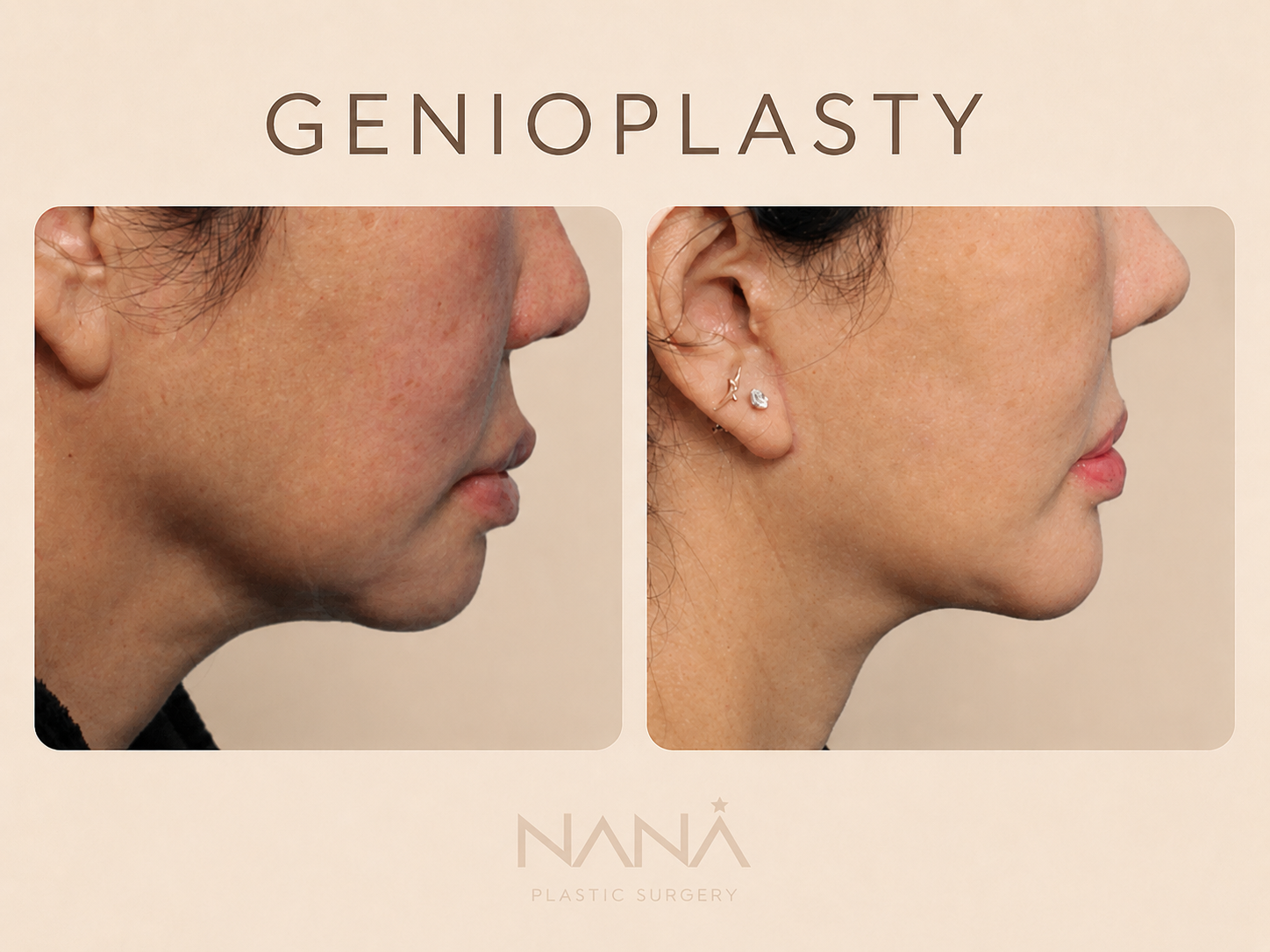
The Three Procedures, Compared
| Weak Chin Surgery | Chin Tip Augmentation | Long Jaw Surgery | |
|---|---|---|---|
| Best for | Recessed or short chin | Flat, undefined chin | Projecting or long jaw |
| Surgical time | 1 to 1.5 hours | ~30 minutes | ~1 hour |
| Anesthesia | Sleep | Sleep | Sleep |
| Bone surgery | Yes (most methods) | No | Yes |
| Daily life | 3 to 5 days | 1 to 2 weeks | 3 to 5 days |
| Result | Permanent | Permanent | Permanent |
What Does an “Ideal” Chin Actually Look Like?
There is no single ideal chin, but balanced proportions tend to read as harmonious on most faces. As a starting point, the face is generally divided into three roughly equal vertical sections: hairline to brow, brow to nose tip, and nose tip to chin. From the front, the cheekbones typically sit about 10% wider than the head, with the lower jaw narrowing approximately 20% from there. These proportions are not strict rules — every face is unique — but they serve as a reference point when surgical planning begins.

Weak or Short Chin Surgery in Korea
When the chin sits noticeably behind the upper jaw, the mouth can appear to project forward even when it does not. This is typically the result of an underdeveloped lower jaw bone, and it is precisely what weak chin surgery is designed to correct. The chin is repositioned or augmented to give the lower face a stronger, more defined line.
Signs you may be a candidate
- Your mouth appears to project forward.
- Your lower jaw sits behind your upper jaw.
- Your chin feels short, with little definition between face and neck.
- Your chin does not match the length of the rest of your face.
- You want a sharper, more refined chin line.
How we correct a weak chin
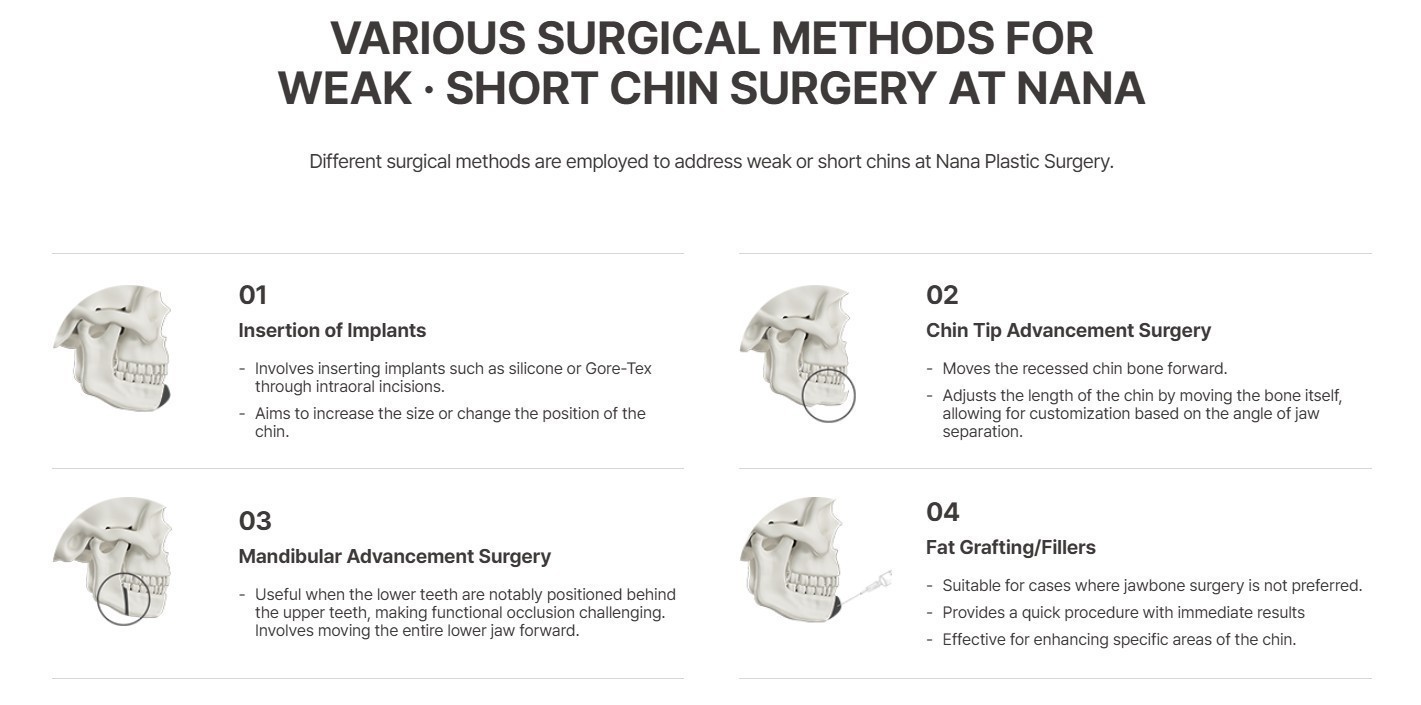
There is no single “right” technique — the chosen method depends on your bone structure, determined through consultation and a 3D CT scan. The main options are:
- Insertion of implants — silicone or Gore-Tex implants placed through intraoral incisions to enhance chin size or position.
- Chin tip advancement — the recessed chin bone is moved forward, with length adjusted by repositioning the bone itself.
- Mandibular advancement — indicated when the lower teeth sit noticeably behind the upper teeth; the entire lower jaw is moved forward to restore functional occlusion.
- Fat grafting or fillers — a non-bone alternative suitable for enhancing specific areas of the chin.
What happens during surgery
For length correction specifically, two main bone-grafting methods are used.
With graft extension using bone plates, planning begins with the CT scan; a section of the central chin bone is then transplanted to extend the chin. The remaining bone is fixed in place and any rough edges are smoothed.
Square chin bone transplant lengthening works similarly but uses both the middle and square portions of the chin bone, with a section repositioned to the center to achieve the desired length before everything is secured back in place.
Chin Tip Augmentation in Korea
Chin tip augmentation builds up the volume of the chin to add definition to the lower face, without bone surgery. A custom silicone implant is designed for each patient’s anatomy, providing a permanent three-dimensional result that does not shrink or sag over time.
The procedure is frequently combined with rhinoplasty. Adjusting both the projection of the chin and the shape of the nose in a single session can transform the side profile significantly.
Who it’s best for
- Your face looks flat or two-dimensional from the side.
- Your chin sits back, making your profile appear weak.
- Your mouth seems to project forward more than you’d like.
- A small chin is making a double chin more noticeable.
- You want a permanent result rather than fillers that require touch-ups.
- You’d rather skip bone surgery, often paired with a nose procedure.

What happens during surgery
Following consultation, a custom implant is fabricated with size and shape chosen specifically for your existing chin contour and aesthetic goals. The procedure itself takes approximately 20 minutes under sleep anesthesia, and a compression bandage is applied immediately afterward to manage swelling.
Recovery
Recovery begins the same day. Patients are discharged after about two hours and asked to keep the upper body elevated to help manage swelling.
- Ice the area for the first 2 to 4 days.
- Compression bandage comes off around day 4.
- Most swelling settles by week 2.
- Sutures dissolve on their own — no removal needed.
- Most patients return to normal activity within 1 to 2 weeks.
- Any tightness during facial movement fades after about a month.
Long or Protruding Jaw Surgery in Korea
A long or protruding jaw occurs when the lower jaw is overdeveloped, or when the upper jaw is underdeveloped and the lower one appears prominent by comparison. Long jaw surgery corrects this by reducing and repositioning the lower jaw to restore facial proportion. Surgical planning considers overall facial ratio, jawline structure, and skin elasticity to determine the most suitable proportions for each patient.
Check yourself: do any of these sound familiar?
- Your jaw area is longer than the middle third of your face.
- Your lower teeth project past your upper teeth.
- The tip of your lower jaw extends past your lips.
- Your face looks long and pointed.
- Certain sounds are harder to pronounce (in Korean, ㅂ and ㅁ sounds).
- The area around your nose looks sunken, making the midface appear hollow.
When long jaw surgery is the right call
- The end of your jaw projects and makes the face appear longer.
- A strong lower jaw is making the midface look recessed by comparison.
- Your face is long and gums show when you smile.
- Your lower jaw is wider than the rest of your face.
- Facial asymmetry combined with a long jaw.
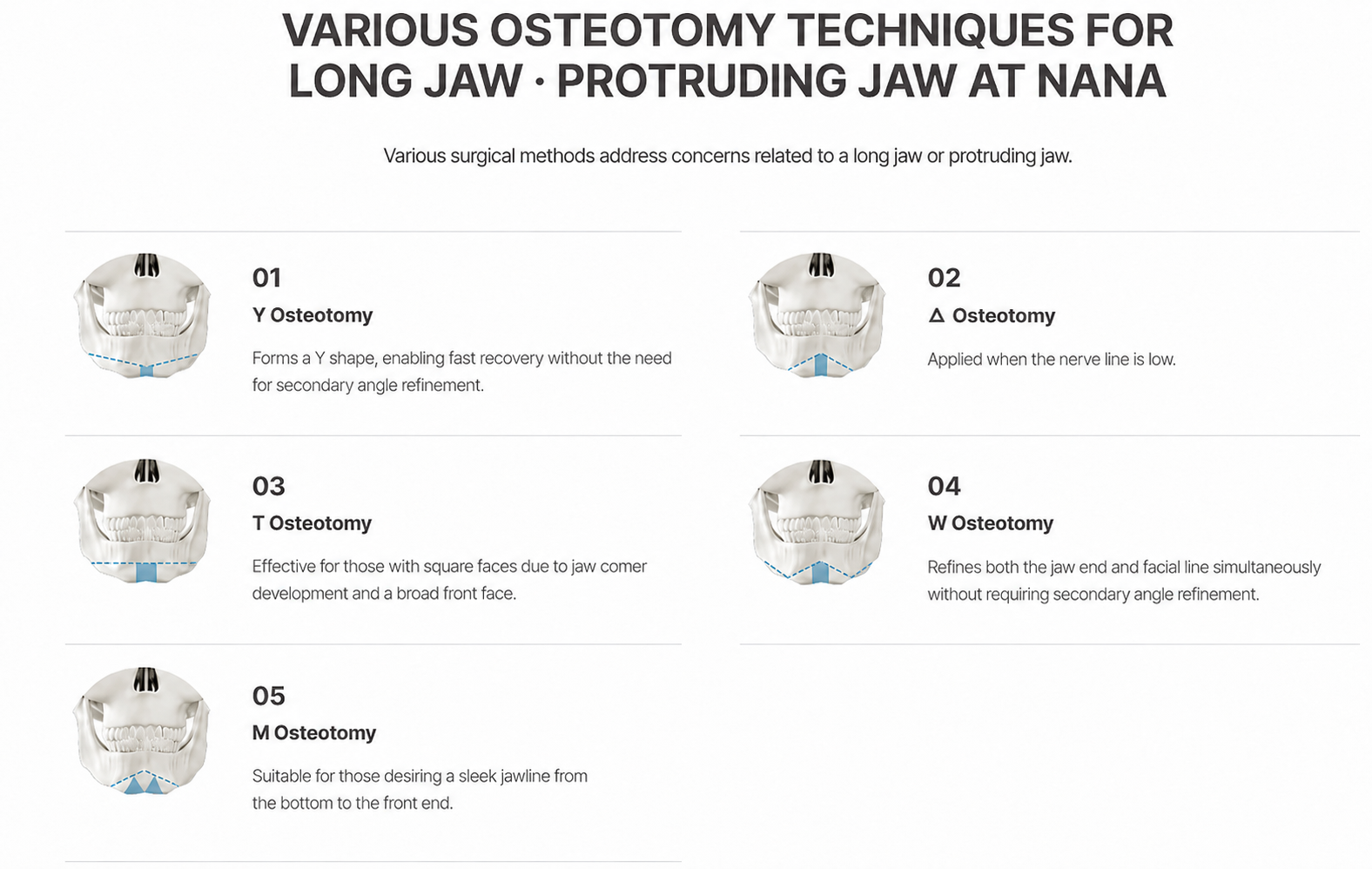
The five osteotomy techniques
NANA uses five different ways to cut and reshape the bone, choosing the technique that best fits each patient’s anatomy and desired result. The advantage of selecting the appropriate technique upfront is that no second surgery is needed later to refine jaw angles.
- Y Osteotomy — a Y-shaped cut in the bone allowing faster recovery.
- △ Osteotomy — used when the nerve line sits lower than average.
- T Osteotomy — best for square faces with prominent jaw corners and a broad front face.
- W Osteotomy — refines both the jaw tip and side jawline in one go.
- M Osteotomy — creates a clean, smooth jawline from bottom to front.
What happens during surgery
The procedure begins with a 3D CT scan of the jawbone. One of the five osteotomy techniques above is then performed based on your anatomy. After cutting and repositioning the bone, the jaw end is reduced and the surrounding muscles are tightened for a smoother, more sculpted lower face.
So Which Chin Surgery Should You Get?
It comes down to facial structure, bone anatomy, and aesthetic goals. A definitive answer requires a consultation with a 3D CT scan, but here is a rough guide to which procedure tends to suit which concern:
- Weak or recessed chin — implants, bone advancement, or moving the whole lower jaw forward.
- Flat chin that needs more volume — chin tip augmentation with a custom silicone implant.
- Long or protruding jaw — one of the five osteotomy techniques (Y, △, T, W, or M).
- Asymmetric chin — 3D bone repositioning, often combined with osteotomy.
Not sure which procedure is right for you? Send us a front and side photo and our team will review it with the doctors, with no obligation.
How We Do Chin Surgery at NANA
- 3D CT scan before every chin procedure, so nothing is left to guesswork.
- Full range of options: implants, bone advancement, osteotomies, fat grafting.
- Customized osteotomy techniques chosen upfront, removing the need for a second surgery to refine jaw angles.
- Planning considers the whole face, not the chin in isolation.
- English-speaking staff and online consultations for international patients.
Questions We Get a Lot
How long does chin surgery last?
How long is the recovery?
How long should I stay in Korea for the surgery?
Will I need to stay in the hospital overnight?
What kind of anesthesia is used?
Can I combine chin surgery with other procedures?
Will it look natural?
Is Korea actually a good place for chin surgery?
Medical Disclaimer: Individual outcomes, recovery times, and surgical plans vary based on each patient’s anatomy, bone structure, skin elasticity, and adherence to postoperative care. All surgical procedures carry risks, and suitability can only be determined through a personal consultation with a board-certified plastic surgeon at NANA Plastic Surgery. This article is for educational purposes and does not replace medical advice.
Whether the chin sits too far back, looks too flat, or projects too far forward, there is a chin surgery suited to the concern — with permanent results. To explore which approach fits your face, reach out and the team will walk you through the options.