
NANA BLOG
The Hidden Risks of Face Lift Surgery No One Explains
Contents
Fewer Risks, Results That Hold:
Facelift Surgery at NANA Plastic Surgery
Swelling and bruising are the easy part. The risks that actually send patients back for revision are structural: a wind-swept lateral sweep, widened scars, a stretched earlobe, and a lift that fades. Here is what really goes wrong in facelift surgery, and how NANA is built to prevent it.

Facelift surgery is one of the most effective anti-aging procedures available today. Performed correctly, it restores facial contours, improves skin laxity, and delivers long-lasting rejuvenation. However, many patients search for terms like facelift surgery gone wrong or facelift complications after seeing unsatisfactory results online. Facelift surgery is a complex structural procedure. It involves the SMAS layer, the retaining ligaments, the fat pads, and delicate nerve branches. When these structures are not properly addressed, the results may look unnatural or fail to last. Understanding the real risks of facelift surgery is essential before choosing a surgeon. At NANA Plastic Surgery in Seoul, our lifting specialists focus on structural lifting techniques designed to reduce complications and create natural results.
Key Takeaways
- Swelling and bruising are normal parts of recovery. The bigger structural risks are the ones most clinics do not fully explain.
- Lateral sweep deformity comes from pulling skin sideways without repositioning the deeper SMAS layer. Many revision patients report this as their primary concern.
- Pixie ear, a stretched earlobe attachment, happens in about 5.7% of cases and is driven by too much tension on the skin at closure.
- NANA lifts the skin and SMAS together as one unit, releases and repositions the retaining ligaments, and anchors the lift to deep tissue with a tension-free closure. Deep plane results last 10 to 15 years.
- Nerve positioning is mapped before surgery with 3D-CT analysis, alongside a pre-operative examination covering over 50 nationally certified test items.
- Five questions to ask any surgeon are listed below. Choosing a technique that addresses deep structures significantly lowers the chance of unnatural results.
Common Facelift Complications
Most clinics mention swelling and bruising. Those are normal parts of recovery. The bigger structural risks are the ones that are rarely explained in full.
Lateral sweep deformity
This occurs when only the skin is pulled sideways without repositioning the deeper SMAS layer. The result can look tight and wind-swept. Many revision patients report this as their primary concern.
Nerve injury
Facelift surgery is performed close to the facial nerve branches. Improper dissection may lead to temporary weakness or, in rare cases, permanent nerve damage affecting facial expression.
Visible or widened scars
Incisions closed under excessive tension can widen or distort the ear shape, and poor placement can affect the hairline. Scar quality is one of the most common reasons patients seek revision surgery.
Short-lived results
When the deeper retaining ligaments and structural layers are not addressed, the lifting effect may not last. Skin tightening alone does not correct three-dimensional aging.
Pixie ear
The earlobe attachment stretches and drooping decreases, usually from too much tension on the skin during closure. It happens in about 5.7% of cases.
Why Some Facelifts Look Unnatural
Facial aging is not only about loose skin. It involves:
- Descent of the fat pads
- Weakening of the retaining ligaments
- Laxity of the SMAS layer
- Volume loss in the midface
Surface-level lifting cannot fully correct these structural changes. When only the skin is tightened, the face may look artificially stretched, and the improvement may fade earlier than expected.
| Skin-only tightening | Structural lift at NANA | |
|---|---|---|
| What is lifted | Skin alone | Skin and SMAS layer together as one unit |
| Retaining ligaments | Not addressed | Carefully released and repositioned |
| Where tension sits | On the incision line | Anchored to deeper tissue layers |
| Typical result | Tight, wind-swept, risk of lateral sweep | Natural movement, softer contour |
| Revision likelihood | Increases the likelihood of needing additional surgeries | Reduces the likelihood of needing future revisions |
| Longevity | May fade earlier than expected | Deep plane results last 10 to 15 years |
This is not our claim alone. As NANA notes on the Mini Facelift page, simply lifting the skin can yield limited results and increase the likelihood of needing additional surgeries. When both the skin and the fascia tissues are lifted and secured, effectiveness is enhanced, results last longer, and the chance of future revision drops.
The right approach still varies with your skin elasticity and degree of sagging, so a consultation and assessment come before any decision.
How NANA Minimizes These Risks
At NANA Plastic Surgery, we focus on structural lifting techniques designed to reduce complications and create natural results. Our medical team has over a decade of experience in lifting surgeries and hundreds of successful procedures.
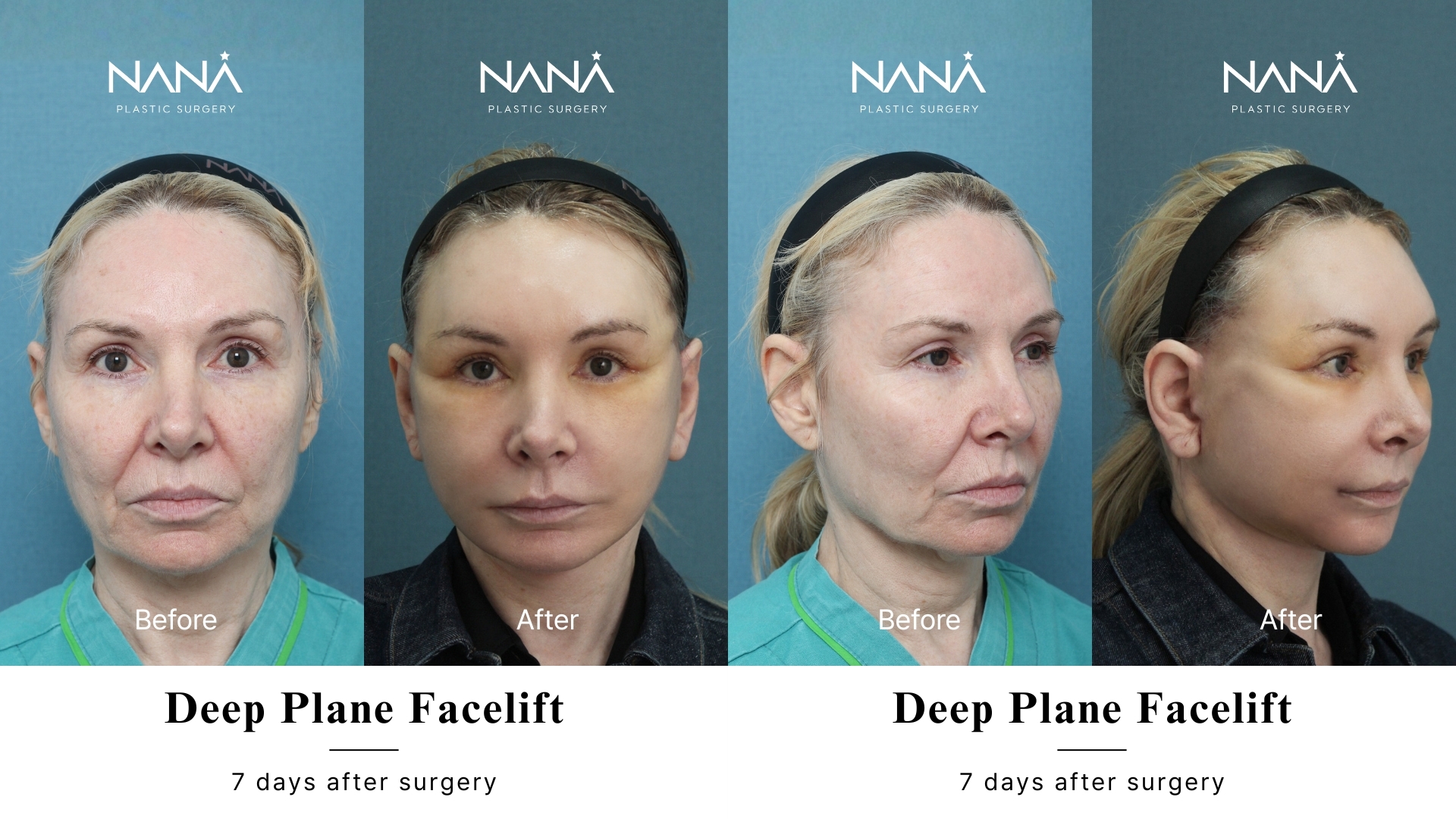
Deep plane and layered lift
Our deep plane approach lifts the skin and SMAS layer together as one unit. Retaining ligaments are carefully released and repositioned, so sagging tissue in the midface, jawline, and neck is restored without excessive skin tension. Supporting the deeper layers rather than relying on skin is what reduces lateral sweep and holds the result longer.
Tension-free closure
Lifting force is anchored to deeper tissue layers rather than the skin, which reduces stress on the incision lines and allows scars to heal thin and discreet. Incisions are placed along natural contours behind the ear to preserve the ear shape and keep scars subtle.
Preserved volume, protected nerves
Our technique repositions rather than aggressively removes. Fat pockets are preserved wherever possible to prevent hollowing, and careful dissection protects the facial nerve branches so natural facial movement is maintained.
Earlobe position control
To prevent pixie ear, skin tension is managed carefully and the earlobe is properly positioned during closure. Precise suturing maintains the natural hang of the lobe, reducing the risk of elongation or drooping and keeping the result smooth.
3D-CT nerve mapping
Nerve injury is designed out before the first incision. We perform a thorough pre-operative analysis using 3D-CT to design the surgery, considering individual facial bone structure, muscle and tissue distribution, nerve positioning, and less visible areas.
Results measured in years
Because the lift is carried by the SMAS layer and the retaining ligaments rather than the skin, our deep plane facelift is built for natural, long-lasting rejuvenation, with results lasting 10 to 15 years.
NANA's Reliable Lifting System
Technique is only half of risk reduction. The other half is what surrounds it.
- Precise pre-operative analysis through 3D-CT. We design the surgery around individual facial bone structure, muscle and tissue distribution, nerve positioning, and less visible areas.
- Pre-operative comprehensive examination system. With over 50 nationally certified test items for disease-specific examinations, we provide individualized, scientifically accurate surgery.
- A teamwork system of specialized medical professionals. Experienced medical specialists in each field collaborate for a safe and satisfying surgical process.
- A resident anesthesiologist is present. Real-time monitoring ensures patient safety from pre-surgery to post-surgery recovery, with dedicated 1:1 care from specialized anesthesiologists.
- Lifting Recovery Management Solution. A comprehensive recovery management solution, including a swelling management program, supports quick and satisfying recovery.
Not sure whether a facelift or a lighter lift fits your face? Send us a clear front and side photo and our team will review it with the doctors, with no obligation.
Which Lift Fits Your Concern?
A full facelift is not the only answer, and choosing more surgery than you need is its own risk. NANA analyzes skin aging, skeletal structure, facial proportions, and degree of sagging to select the most suitable method. Lifting for someone in their 20s to 30s concerned about skin laxity after contouring surgery differs from lifting for someone in their 40s to 50s dealing with natural aging.

Deep Plane Face Lift
Advanced SMAS layer lifting with retaining ligament release for natural, long-lasting facial rejuvenation. Results last 10 to 15 years.

Mini Face Lift
Lifts both skin and fascia using four types of threads for powerful, long-lasting results. Creates a V-line effect without bone surgery, with immediate return to daily life.

Micro Face Lift
A roughly 2cm incision hidden within the scalp, lifting and excising sagging skin. Recommended for those not satisfied with thread lifting, with reduced recovery and scarring versus a traditional facelift.

Forehead & Brow Lift
An endoscopic lift for sagging brows, forehead wrinkles, and glabellar lines through a 1 to 2cm hairline incision with Endotine fixation. Minimal scarring, return to daily life in 1 to 2 days.

Neck Lift
Tightens loose neck skin, removes a double chin, and restores a defined jawline. Addresses the SMAS layer as well as skin. Submental and full neck lifting available, with return to daily life in 1 to 2 days.

Thread Lift
Four types of PDO thread, certified by the MFDS and the U.S. FDA, inserted into different layers of the skin. No incisions, no scars, immediate return to daily life. Patients not satisfied with thread lifting are often candidates for a micro or mini lift instead.
Recovery at a glance
| Thread Lift | Micro Face Lift | Neck Lift | |
|---|---|---|---|
| Surgical time | 10 to 20 minutes | 30 minutes to 1 hour | 1 hour |
| Anesthesia | Local anesthesia | General anesthesia | General anesthesia |
| Hospitalization | Not required | Not required | Not required |
| Suture removal | Not required | After 1 week | 7 days after surgery |
| Return to daily life | Immediate | Immediate | 1 to 2 days after surgery |
| Follow-up treatment | Not required | 2 to 3 days after surgery | 1 session |
A neck lift is often combined with a facelift to improve overall facial balance and achieve more comprehensive rejuvenation of the lower face and neck.
How to Reduce the Risk of Facelift Complications
If you are considering facelift surgery, ask the following:
- How is the SMAS layer addressed
- Are the retaining ligaments released
- What method is used for scar closure
- How is tension distributed during lifting
- Does the surgeon have revision experience
Choosing a technique that addresses deep structures significantly lowers the chance of unnatural results.
Is Facelift Surgery Safe?
Facelift surgery can be safe and highly effective when it is performed by an experienced facial plastic surgeon who prioritizes anatomical precision and individualized planning. The goal is not to avoid surgery entirely. The goal is to select the appropriate technique and the appropriate surgeon.
Compare the related options on the Facelift, Mini Facelift, and Thread Lift pages.
The Care Around Your Surgery
Accredited by Medical Korea
A medical institution accredited by Medical Korea for attracting foreign patients, under the Ministry of Health and Welfare.
Seoul & Gangnam-Gu Medical Tourism
Partnering with the Seoul Medical Tourism Alliance and Gangnam-Gu Medical Tourism, in Apgujeong, Gangnam.
Over a Decade of Lifting Experience
A medical team with over a decade of experience in lifting surgeries and hundreds of successful procedures, with specialized expertise in natural movement.
Resident Anesthesiologist On-Site
Real-time monitoring from pre-surgery to post-surgery recovery, with dedicated 1:1 care from specialized anesthesiologists.
Officially Designated Stem Cell Care
Officially designated for advanced stem cell-based regenerative care, applied to support smoother recovery where suitable.
English-Speaking International Team
Care coordinated in English alongside seven other languages, for patients travelling to Seoul from abroad.
Frequently Asked Questions
Is facelift surgery safe?
What is lateral sweep deformity?
What is pixie ear and how is it prevented?
Can a facelift damage the facial nerves?
Why do facelift scars sometimes widen?
Why do some facelift results not last?
Why do some facelifts look unnatural?
What should I ask a surgeon before a facelift?
How long does a deep plane facelift last?
Does lifting the skin alone increase the chance of revision surgery?
How does NANA protect the facial nerves during a facelift?
What is the difference between a facelift and a neck lift?
Medical Disclaimer: This article is for general informational purposes only and does not constitute medical advice. All surgical procedures carry risks, and suitability, technique, recovery, and expected results can only be determined through a personal consultation with a board-certified plastic surgeon at NANA Plastic Surgery.